Release Notes
Stay up to date with the latest improvements, new features, and fixes across all MousePlugins.
Quality you can trust
Every update is tested for stability and performance.
Always improving
We listen, iterate, and ship updates that matter.
We're here to help
Real humans. Real support. Real fast.
Sep 16, 2026
Latest
Aug 27, 2026
Cambridge Bus Compressor
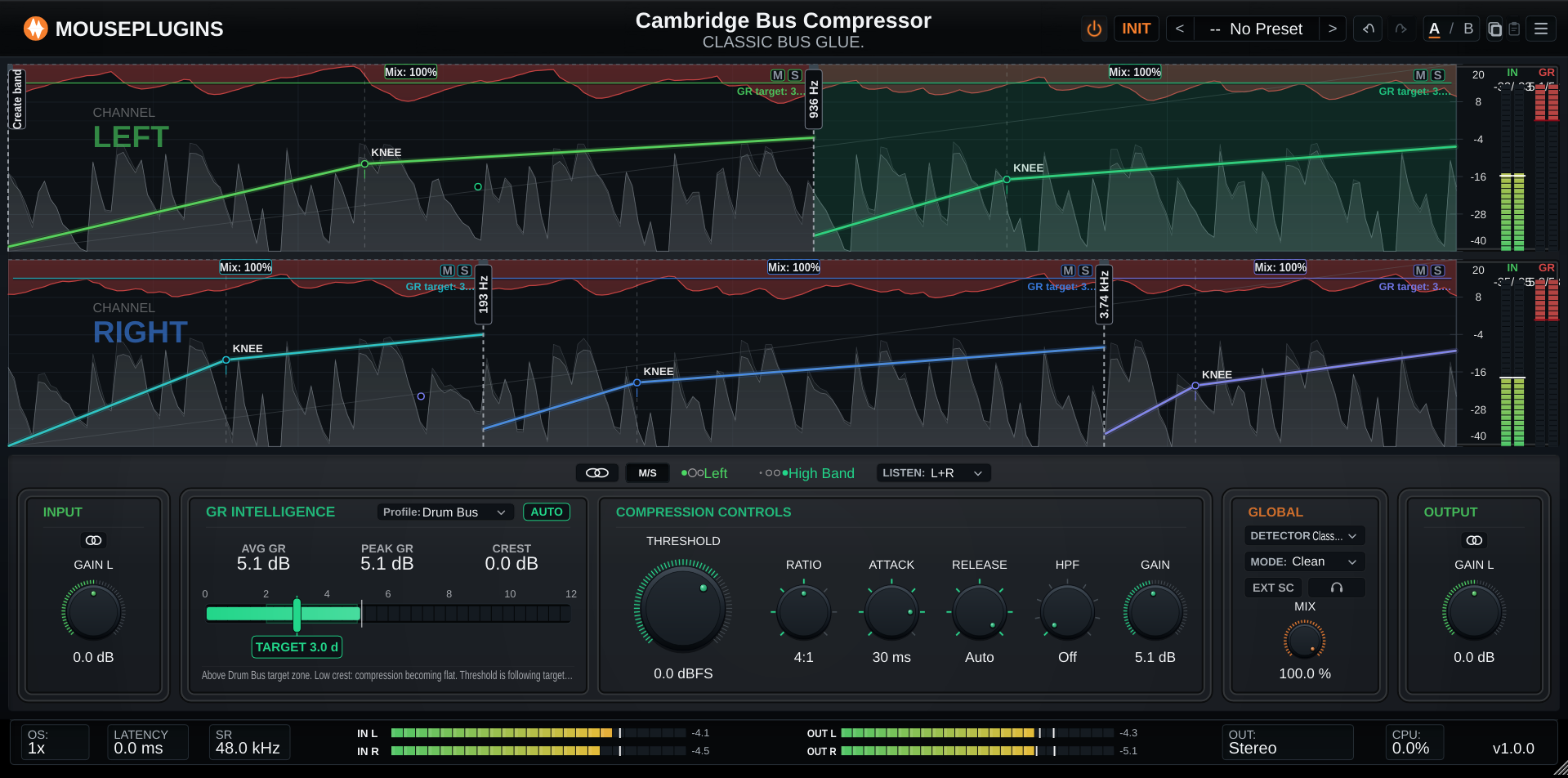
Three-band bus compression with two independent lanes and guided GR Intelligence v1.0.0Initial release highlights - Calibrated bus-compressor model with 20 factory presets. - Stereo Linked, independent L/R, and M/S routing. - Stereo Linked uses lane A as the single runtime authority for compressor controls and crossover on both channels; stored lane B settings resume when routing is unlinked. - Independent lane/band control with asymmetric multiband layouts. - Processor-owned Auto GR with editor-open/headless equivalence. - Auto GR disengage commits both effective Threshold and level-restoring Gain, preserving the manual handoff without a level jump. - While Auto GR is active, the GAIN control follows the effective live makeup offset without writing host automation or changing the stored manual value. - Manual GAIN drag, typed-value, and default gestures during Auto GR target the displayed effective Gain without double-counting the live makeup offset. - Visible Mode, Detector Mode, external sidechain, sidechain-listen, and routing-aware Listen controls, synchronized with host automation and state. - Per-channel metering, bypass/state synchronization, and deterministic recall. - Fixed native-rate 1x processing with zero oversampling latency. - VST3 and CLAP formats. - Free product: no licence, activation, trial, demo interruption, or network use.
Aug 07, 2026
Cambridge Channel Strip
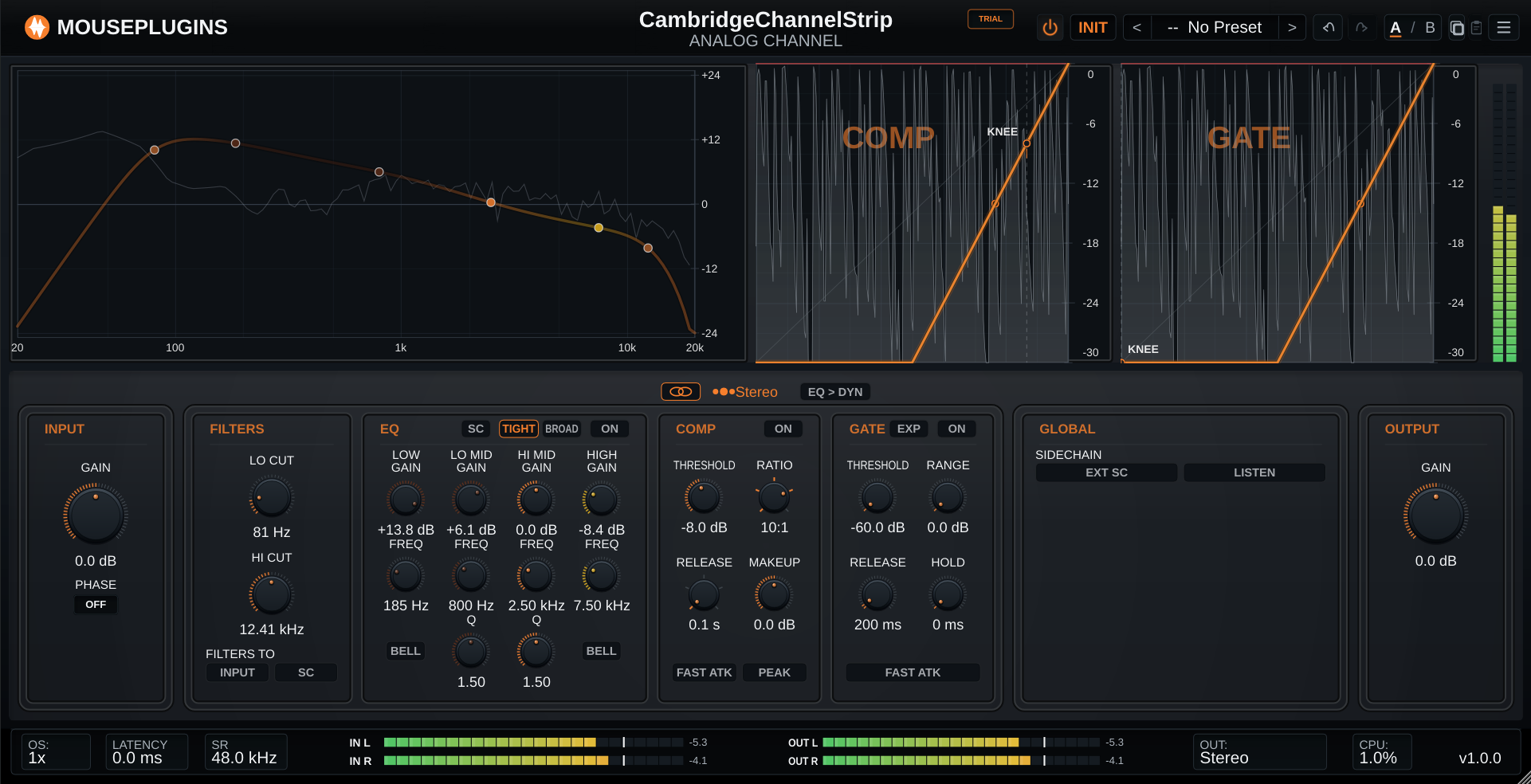
Filters, four-band EQ, compressor and gate — with two independent lanes v1.0.0Cambridge Channel Strip is a console-style channel strip in a single plugin: input conditioning and phase, high- and low-pass filters, a four-band EQ, a compressor and a gate/expander sharing one dynamics section, a global sidechain, and output trim. Work in linked Stereo, or split into two independent lanes with full Left/Right and Mid/Side routing. This is the first public release. It runs in demo mode until activated with a licence key: every control is active and there is no time limit, but a 2-second silence interruption occurs every 60 seconds and is printed into renders and exports.
- The EQ graph now uses a symmetric gain axis: +/-24 dB with 0 dB at the centre, signed labels, and an emphasised unity line. Previously the axis was labelled as gain reduction (0 down to -12), which did not describe the curve being drawn - the centre of the plot was 0 dB but was labelled -6.
- Removed the "LIVE CORRECTION" overlay. That trace plots dynamic gain reduction; this is a static EQ, so it always reported zero and drew a flat line pinned to the top of the graph under a label for a feature the plugin does not have.
- Widened the EQ response curve for legibility.
- Footer now reports a fixed 1x rate rather than implying a selectable oversampling stage. The engine runs at the host sample rate.
- Lane parameters are stated explicitly in the unlinked-lane tests, and the delegated processor contracts are covered by tests.
- Release builds can no longer report false-green test runs: assertions are kept live under Release (WsscAssertGuard).
- + 8 more — View details
Aug 06, 2026
Mastino 60
Punchy Multiband VCA Compressor v2.0.2
FIXED
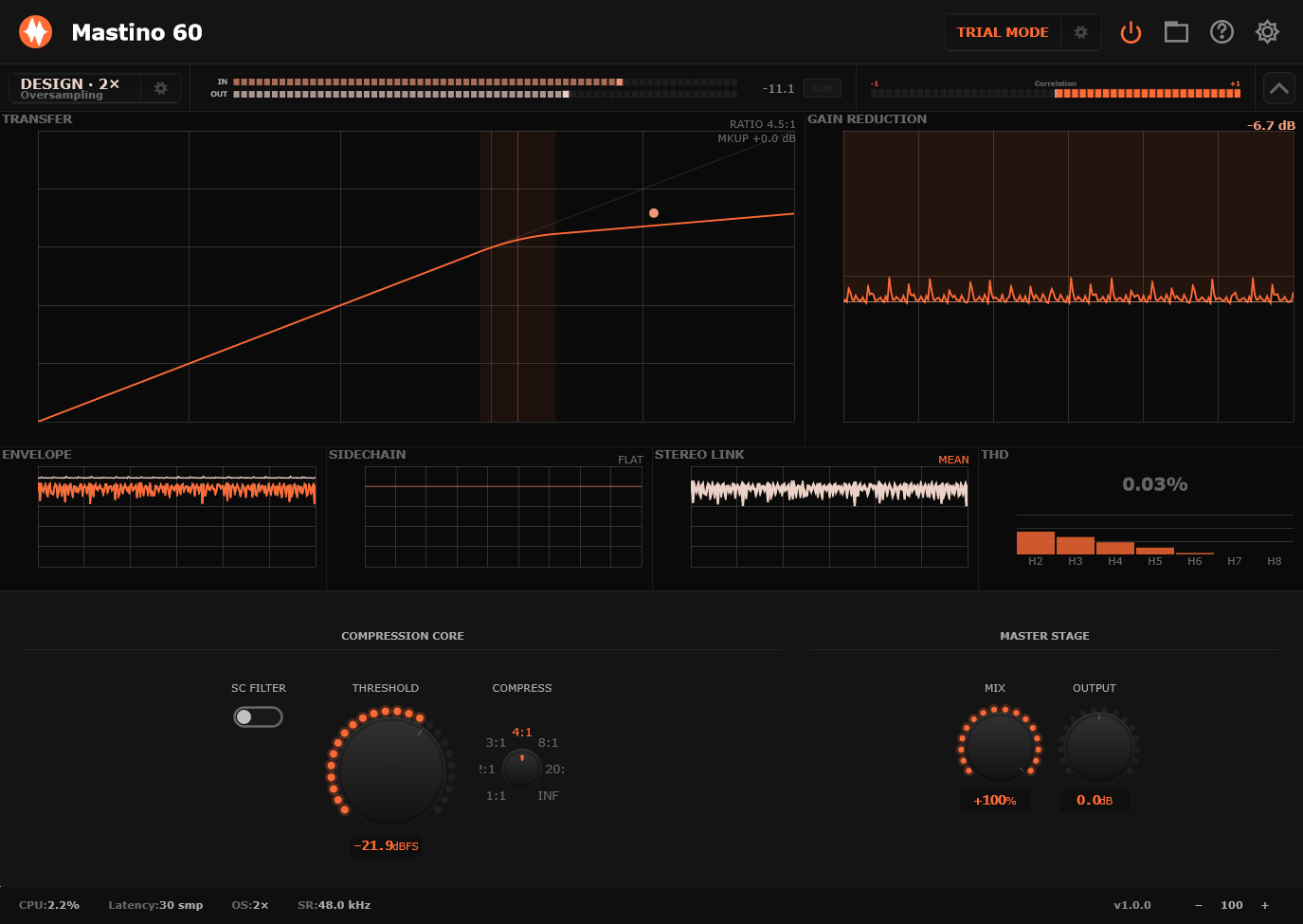
Mastino 60 v2.0.2 is a feature release. It adds per-band CLIP and clickable, plain-language help across the compression chart, makes the editor resize proportionally, gives the Gain Reduction Intelligence and Global panels more room, and fixes a handful of behaviour, stability, and gain-staging issues from the 2.0.x cycle. Existing projects, presets, licenses, and activations remain compatible. Every new control defaults to its previous behaviour, so a v2.0.1 session sounds identical until you reach for the new features.
Jul 01, 2026
Mastino 60
Punchy Multiband VCA Compressor v2.0.1
FIXED
Mastino 60 v2.0.1 is a small maintenance release that fixes one audible bug introduced during the v2.0.0 release-candidate cycle. Existing projects, presets, licenses, and activations remain compatible. Nothing needs to change in your sessions.
Jun 30, 2026
Mastino 60
Punchy Multiband VCA Compressor v2.0.0
ADDED
IMPROVED
FIXED
Mastino 60 v2.0.0 is a major workflow and interface update. This release rebuilds the plugin around the new MousePlugins v2 editor system, with a clearer graph-first layout, redesigned controls, improved metering, Gain Reduction Intelligence, smarter multiband editing, contextual help, and many stability and usability fixes. Existing projects, presets, licenses, and activations remain compatible.
- average gain reduction
- peak gain reduction
- crest information
- source profiles
- draggable Target GR
- Auto Target threshold following
- + 43 more — View details
Jun 19, 2026
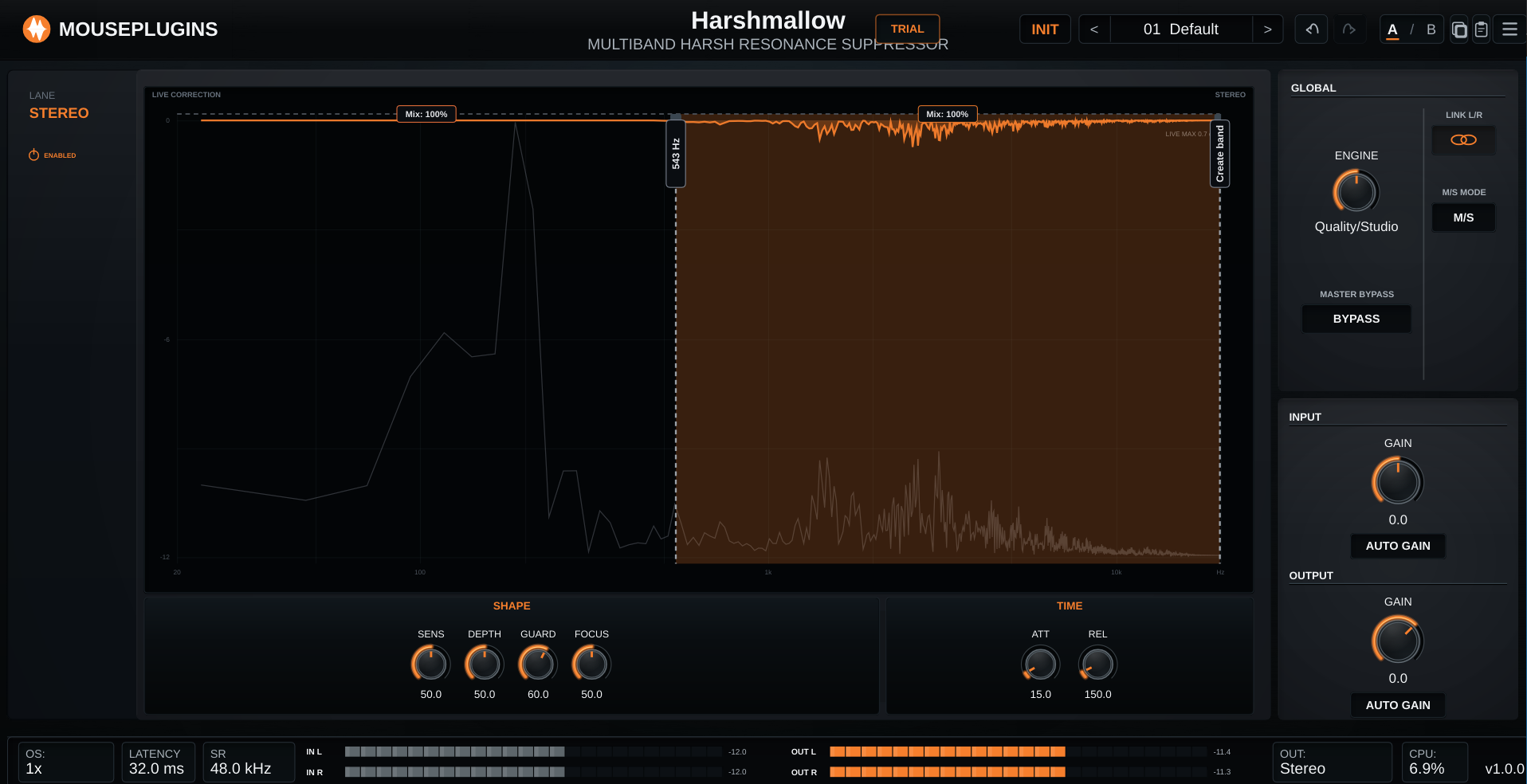
Harshmallow
Multiband harsh resonance suppressor v1.0.1
FIXED
This is a maintenance update that resolves a plugin-scanning issue which could prevent Harshmallow from loading in some hosts. Audio processing, parameters, and presets are unchanged from v1.0.0.
Jun 13, 2026
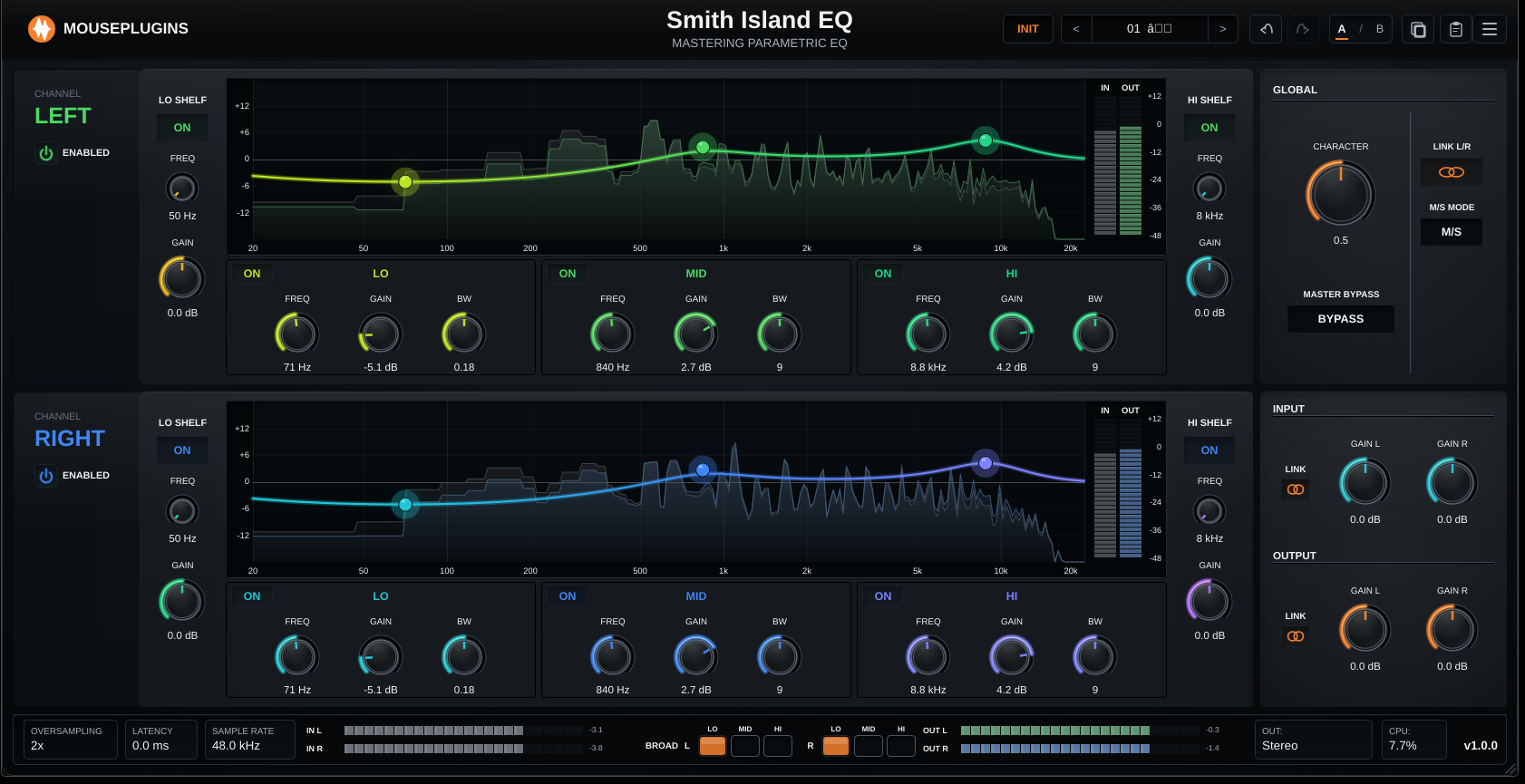
Smith Island EQ
Stereo mastering equaliser v1.2.1
FIXED
This update brings the EQ voicing closer to the discrete analog reference, with refined shelf knee positions and tighter per-band peaking widths.
Jun 13, 2026
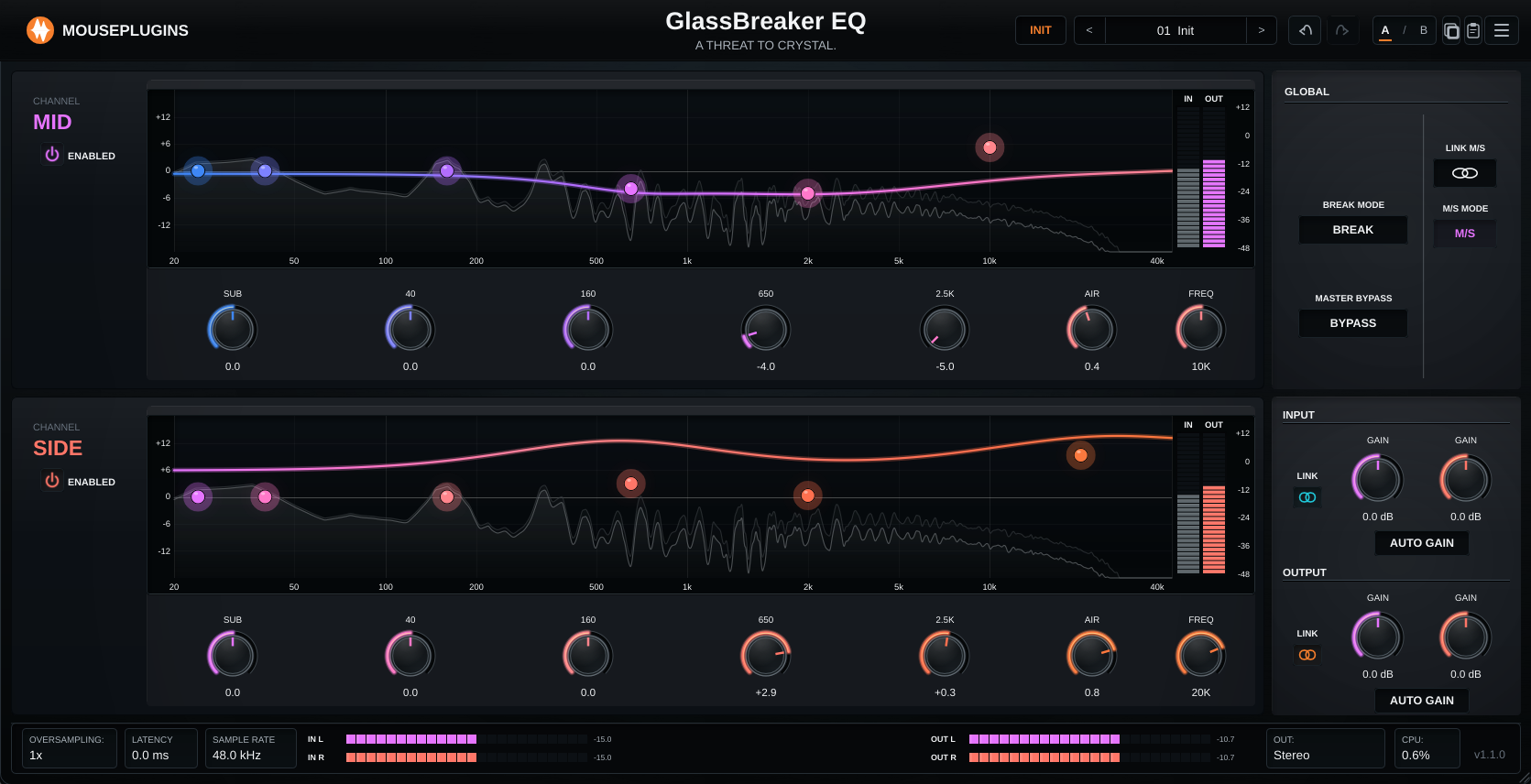
GlassBreaker EQ
High-frequency air & presence EQ v1.2.1
FIXED
This update refines the 2.5 kHz and 40 Hz band voicing for a closer match to the analog reference, with lane behaviour validated across linked stereo, independent L/R, and Mid/Side processing.
Jun 12, 2026
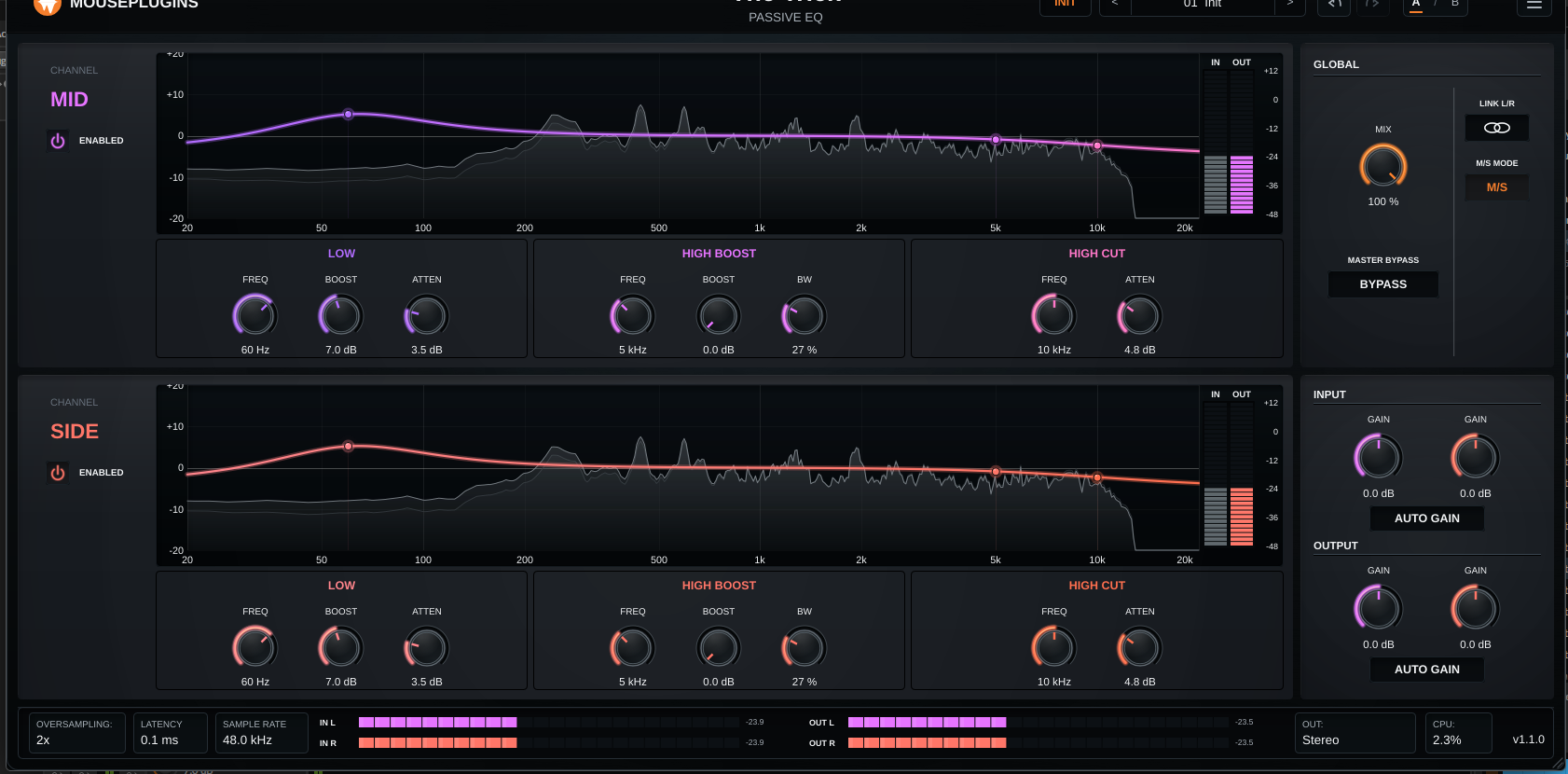
The Trick
Passive EQ curves for musical tone shaping v1.2.1
FIXED
This update focuses on cleaner stereo routing, and more reliable validation across linked stereo, L/R, and M/S operation.
Jun 12, 2026
Mastino 60
Punchy Multiband VCA Compressor v1.2.1
FIXED
This update tightens the Mastino 60 compression voicing against the reference compressor profile, with multiband lane behaviour validated across independent L/R and Mid/Side processing.
Jun 12, 2026
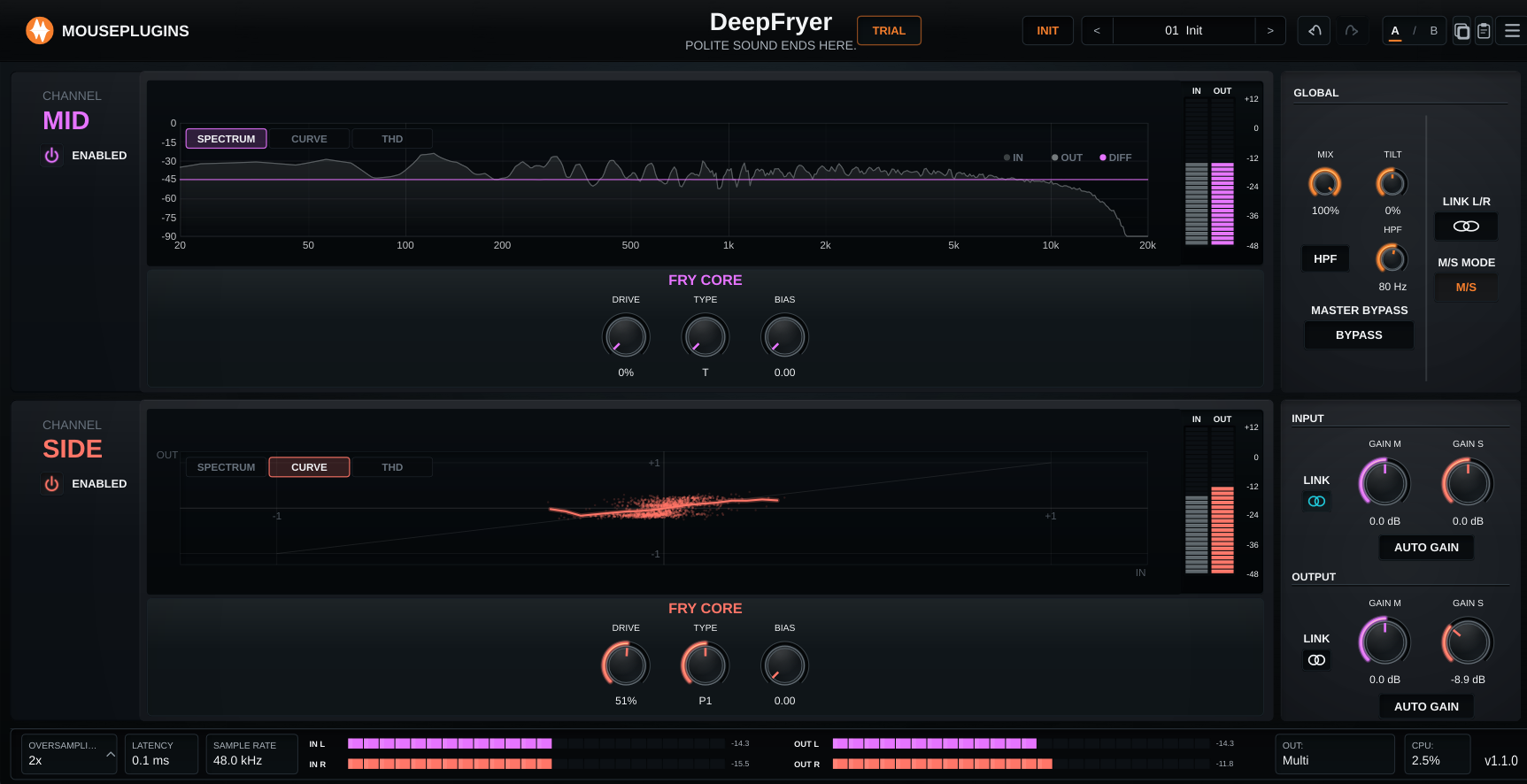
DeepFryer
Multiband tube saturation v1.2.1
FIXED
This update brings the saturator character in faster as you turn up the Drive knob, with internal validation that each band behaves the same across linked stereo, independent L/R, and Mid/Side routing.
Jun 08, 2026
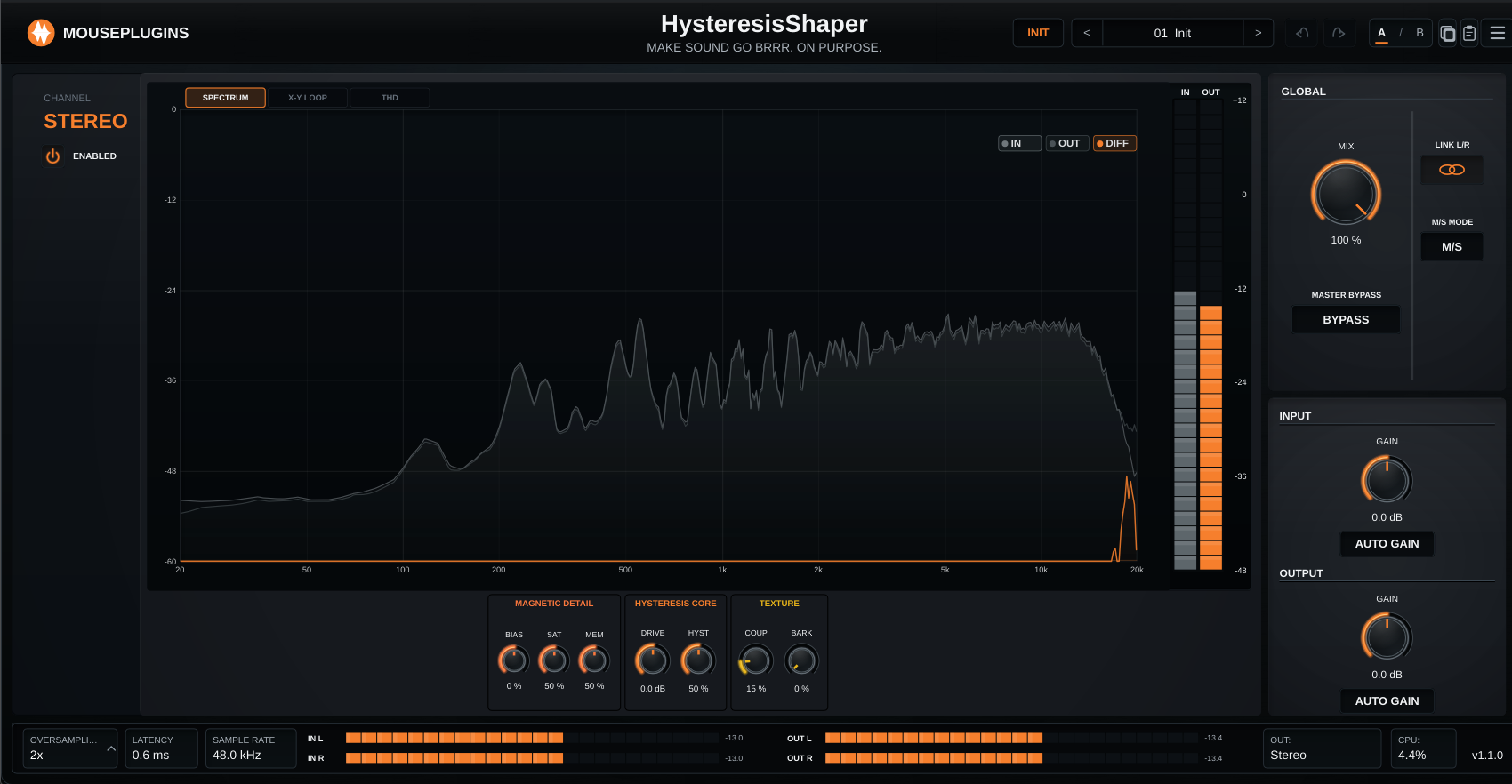
Hysteresis Shaper
Multiband Tape Saturator v1.2.1
FIXED
Final v1.2.1 release: the v1.2.0-beta multiband redesign is now the current stable package, with lower CPU in mono/unlinked routing and a cleaner lane UI.
Jun 08, 2026
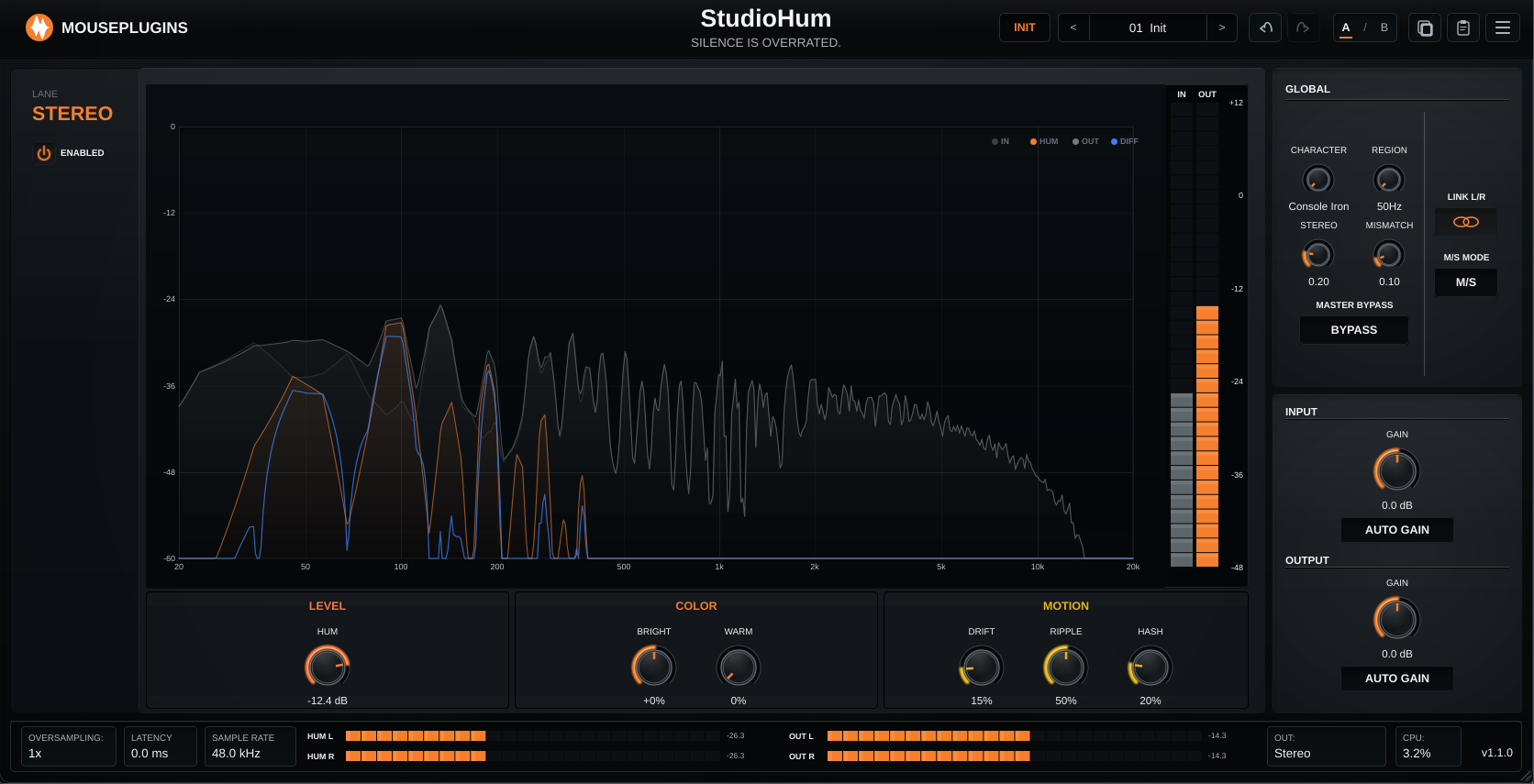
StudioHum
Studio hardware hum and electrical noise v1.2.0This update focuses on UI consistency, host compatibility, and clearer visual feedback.
- Improved full-window scaling so the main chart/control area uses available space better on Windows and Linux.
- Footer controls are ordered consistently with the v1.2.0 plugin series.
- OUT in the footer now reflects the actual outgoing feed: mono when the output behaves as mono, stereo otherwise.
- Spectrum/chart display fixes:
- Silent charts no longer draw misleading sloped spectrum lines.
- DIFF follows the signed OUT dB - IN dB convention.
- + 7 more — View details
Jun 08, 2026
GlassBreaker EQ
High-frequency air & presence EQ v1.2.0GlassBreaker EQ v1.2.0 is a UI, workflow and host-stability update. It brings shared MousePlugins 1.2.0 fixes into the editor while keeping existing sessions compatible.
- Ctrl/Cmd+Z and Ctrl/Cmd+Y for Undo / Redo
- Ctrl/Cmd+C and Ctrl/Cmd+V for Copy / Paste
Jun 08, 2026
The Trick
Passive EQ curves for musical tone shaping v1.2.0The Trick v1.2.0 is a UI, workflow and host-stability update. It brings the editor in line with the current MousePlugins 1.2.0 layout while keeping existing sessions compatible.
- Ctrl/Cmd+Z and Ctrl/Cmd+Y for Undo / Redo
- Ctrl/Cmd+C and Ctrl/Cmd+V for Copy / Paste
Jun 08, 2026
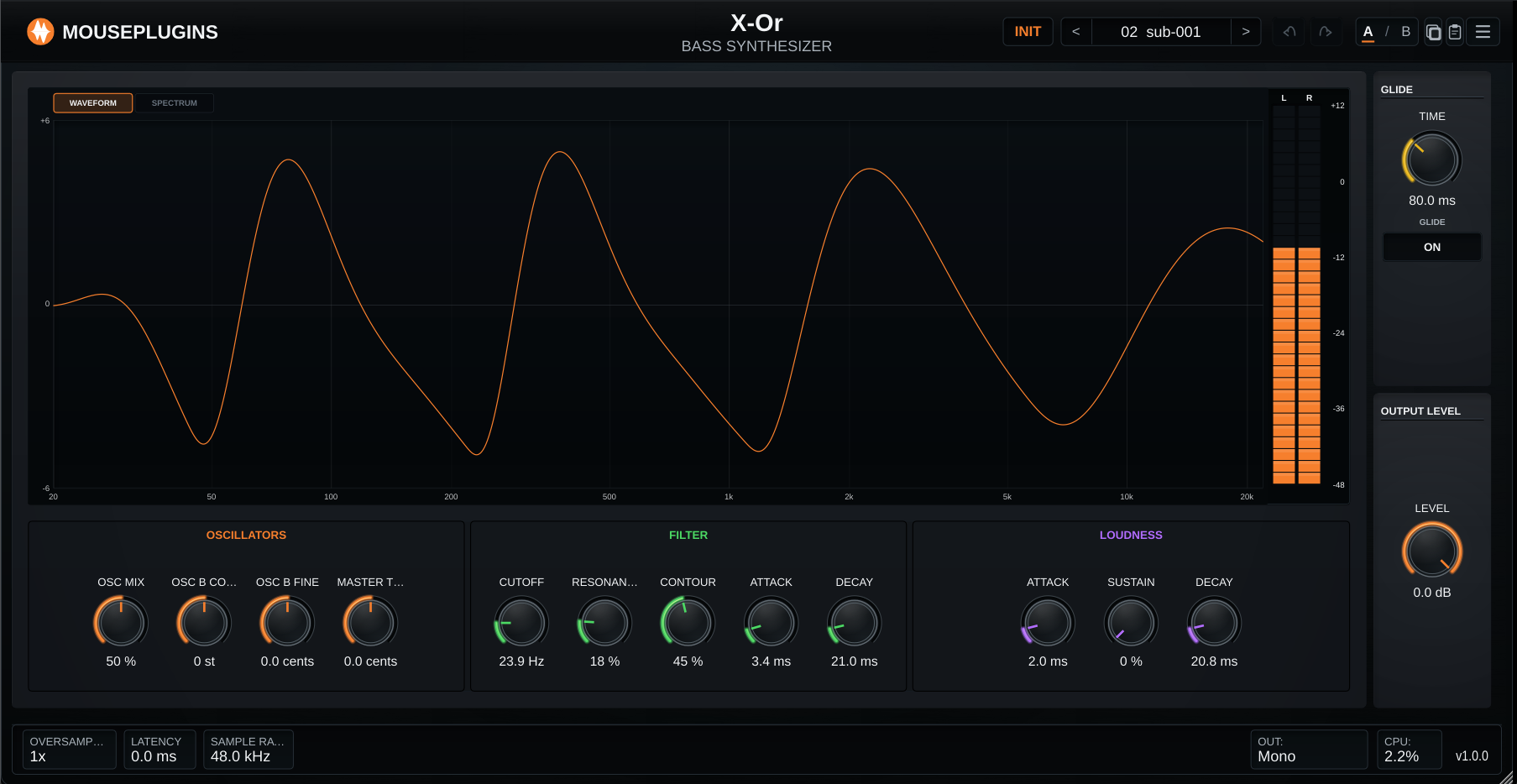
X-Or
Mono sub-bass synth v1.0.3
FIXED
Voice-handling hotfix for X-Or.
- Fast repeated notes (1/16 bass repeats, same note held and re-struck, lower-note steals, higher held-note arrivals while a note is gated) now produce a distinct attack on every key press. Previously the envelope could merge consecutive hits into one held note, especially with non-tiny decay settings - effectively a haunted sustain pedal. Every accepted note-on now restarts the envelope from zero (strict mono retrigger).
- Note releases now decay at the last played pitch instead of jumping to a fixed A. Previously, when a note-off emptied the voice stack the oscillator target collapsed to the internal idle pitch (MIDI A2) while the release tail was still audible, so every note's release tail rang as A. The voice state now latches the most recently sounding note and preserves it across the release tail; the idle pitch is only used at startup and after reset.
- Eliminated the audible click on hard retriggers with short attack and non-tiny decay. The strict mono retrigger above slams the loudness envelope to zero before re-attacking, which produced a step discontinuity (and an audible click) whenever the prior note still had gain - typically with loudness attack below ~0.8 ms combined with decay above ~12-15 ms. A short 2 ms crossfade at the VCA input now rides the prior loudness gain down to zero while the new attack rises, keeping the loudness output continuous without changing the retrigger semantic (the envelope itself still slams and restarts). The window is sized to mask the slam under all currently tested hosts including Ableton Live (which exposed residual crackle at a shorter 1 ms window).
- Pitch selection rules are unchanged: low-note priority still governs which held note sounds. Only the envelope retrigger and release-tail pitch behavior changed.
- Note-off uncovering a held higher note still does not retrigger - that case remains a smooth pitch follow with no fresh attack.
- X-Or remains transposed by design: incoming MIDI notes are still played one octave down, so MIDI A2 triggers A1.
Jun 08, 2026
Mastino 60
Punchy Multiband VCA Compressor v1.2.0Mastino 60 v1.2.0 is a UI, workflow and host-stability update. It keeps the Mastino 60 custom compressor interface intact while bringing in the shared MousePlugins 1.2.0 reliability and workflow fixes.
- Ctrl/Cmd+Z and Ctrl/Cmd+Y for Undo / Redo
- Ctrl/Cmd+C and Ctrl/Cmd+V for Copy / Paste plugin state
Jun 08, 2026
Harshmallow
Multiband harsh resonance suppressor v1.0.0
ADDED
First release — an adaptive de-harsher that tames harsh resonances only while they flare, then lets go.
Jun 07, 2026
DeepFryer
Multiband tube saturation v1.2.0
FIXED
Multiband saturation, a refreshed editor, and host-stability fixes.
Jun 05, 2026
X-Or
Mono sub-bass synth v1.0.2
ADDED
FIXED
Maintenance update for X-Or.
- Updated the editor to the shared MousePlugins instrument scaffold for a cleaner, consistent header, chart, body-control, side-panel, and footer layout.
- Added the Support panel with plugin, host, system, documentation, and diagnostic information.
- Fixed MIDI key-release handling for hosts and controllers that encode note release as Note On with velocity 0. X-Or now treats velocity-zero Note On as Note Off, preventing release events from retriggering or sustaining the voice.
- Hardened plugin/editor teardown so CLAP unload in REAPER is deterministic during project close and does not leave active DSP/analyzer or pending editor callbacks behind.
- Improved REAPER/CLAP shutdown behaviour when closing a project.
- Improved Windows graphics-cache cleanup during plugin unload.
- + 1 more — View details
Jun 05, 2026
Smith Island EQ
Stereo mastering equaliser v1.2.0
FIXED
This update focuses on a cleaner editor, better host reliability, and small workflow fixes.
- Ctrl/Cmd+Z: Undo
- Ctrl/Cmd+Y or Shift+Ctrl/Cmd+Z: Redo
- Ctrl/Cmd+C: Copy plugin state
- Ctrl/Cmd+V: Paste plugin state
Jun 01, 2026
X-Or
Mono sub-bass synth v1.0.1
IMPROVED
Patch release for X-Or v1.0.1.
May 28, 2026
X-Or
Mono sub-bass synth v1.0.0
ADDED
First release of X-Or — a free, two-oscillator monophonic bass synthesizer designed for pedal-bass and sub-bass work.
May 27, 2026
Hysteresis Shaper
Multiband Tape Saturator v1.2.0
FIXED
Shared UI infrastructure update. Multiband â every band gets its own Hysteresis processi
May 22, 2026
The Trick
Passive EQ curves for musical tone shaping v1.1.1
IMPROVED
Stability and polish update.
- the spectrum now uses the intended +4.3 dB/oct display tilt
- the spectrum trace hides cleanly during silence instead of drawing a misleading rising floor line
May 20, 2026
GlassBreaker EQ
High-frequency air & presence EQ v1.1.0
ADDED
IMPROVED
FIXED
GlassBreaker EQ v1.1.0 is a major usability and workflow update. The sound and core EQ concept remain familiar, but the plugin is now much clearer to operate, easier to read, and better prepared for everyday DAW work.
May 20, 2026
DeepFryer
Multiband tube saturation v1.1.0
ADDED
IMPROVED
Feature release - redesigned interface, lane controls, charts, and licensing.
May 20, 2026
StudioHum
Studio hardware hum and electrical noise v1.1.0A workflow-focused update: clearer gain control, easier licensing, and a smoother first-run experience.
- Use linked stereo for normal work.
- Use independent left/right when you need separate channel trims.
- Use mid/side-style lane control when that fits the mix better.
- When Input Auto Gain is active, the matching manual input link controls are hidden.
- When Output Auto Gain is active, the matching manual output link controls are hidden.
- This keeps the UI focused on the controls that are actually active.
- + 13 more — View details
May 20, 2026
Hysteresis Shaper
Multiband Tape Saturator v1.1.0
IMPROVED
This update improves the trial experience and makes Linux installation easier. * Trial mode is now silent during demo interruptions. The previous trial reminder could produce a loud noise burst. In v1.1.0, HysteresisShaper uses short silent interruptions instead, so you can keep evaluating the plugin without unexpected loud sounds. * Linux packages now include install and uninstall scripts. The Linux build includes helper scripts for installing or removing the packaged plugin formats more easily.
May 18, 2026
The Trick
Passive EQ curves for musical tone shaping v1.1.0The Trick v1.1.0 expands the stereo workflow, adds Input and Output Auto Gain, and ships a redesigned Support panel.
- Linked Stereo
- Independent L/R
- Independent M/S
- Linked Stereo paints a warm orange flow across the lane.
- Independent L/R paints GAIN L green and GAIN R blue.
- Independent M/S paints MID magenta and SIDE red.
May 16, 2026
Mastino 60
Punchy Multiband VCA Compressor v1.1.0This update focuses on faster gain staging, cleaner level matching, and a more flexible stereo workflow.
May 16, 2026
Smith Island EQ
Stereo mastering equaliser v1.1.0Smith Island EQ v1.1.0 improves the linked Stereo workflow and makes the plugin easier to use on smaller Windows displays.
May 15, 2026
DeepFryer
Multiband tube saturation v1.0.2
IMPROVED
Maintenance release - license activation workflow improvement.
May 12, 2026
Smith Island EQ
Stereo mastering equaliser v1.0.1* Fixed the Windows release build package.
May 12, 2026
Smith Island EQ
Stereo mastering equaliser v1.0.0Initial release - a stereo parametric mastering equaliser tuned for confident musical moves on the mix and master bus.
May 01, 2026
Mastino 60
Punchy Multiband VCA Compressor v1.0.0Initial release - a fast, punchy VCA compressor with classic vintage-style feel.
Apr 29, 2026
GlassBreaker EQ
High-frequency air & presence EQ v1.0.1
IMPROVED
FIXED
Maintenance release - license activation workflow improvement.
Apr 27, 2026
The Trick
Passive EQ curves for musical tone shaping v1.0.1
IMPROVED
Maintenance update.
Apr 26, 2026
DeepFryer
Multiband tube saturation v1.0.1
FIXED
Maintenance release — bug fixes and DAW integration improvements.
Apr 01, 2026
The Trick
Passive EQ curves for musical tone shaping v1.0.0
ADDED
Initial release.
- Circuit-modeled passive EQ network (WDF tree)
- LF Boost + LF Atten with shared frequency selector (20/30/60/100 Hz)
- HF Boost with 7-position frequency selector (3–16 kHz) and Bandwidth control
- HF Atten with independent 3-position frequency selector (5/10/20 kHz)
- Tube makeup gain stage with transformer voicing (always in signal path)
- Four Quality modes: Eco (1x), Normal (2x), HQ (4x), Ultra (8x)
- + 3 more — View details
Apr 01, 2026
GlassBreaker EQ
High-frequency air & presence EQ v1.0.0
ADDED
Initial release.
- Measurement-fitted musical EQ with five fixed-frequency bands
- Signature Air Band with five selectable frequencies (2.5K–40K)
- Complementary filter bank — flat when all bands are equal
- Break mode — alternative voicing with even-harmonic enrichment
- Zero latency IIR processing
- Offline cryptographic licensing
Apr 01, 2026
DeepFryer
Multiband tube saturation v1.0.0
ADDED
Initial release.
- Measurement-fitted tube saturation with H2/H3 crossover between Drive 50–80%
- Three tube types: T (triode), P1 (pentode #1), P2 (pentode #2)
- Bias control for asymmetric H2/H3 skew
- Pre-saturation HPF (20–500 Hz)
- Post-saturation Tilt (±6 dB around 1 kHz)
- Four Quality modes: Live (1×), Design (2×), Mix (4×), Master (8×)
- + 2 more — View details
Apr 01, 2026
Hysteresis Shaper
Multiband Tape Saturator v1.0.0
ADDED
Initial release.
- Jiles-Atherton magnetic hysteresis model (field-domain ODE)
- Drive, Hysteresis, Saturation, Memory, Bias controls
- Coupling and Barkhausen noise for advanced texture
- Four quality modes: ECO (1×), NORMAL (2×), VINTAGE (4×), INSANE (8×)
- Dry/wet Mix with bit-exact bypass at 0%
- DC blocker, emergency mute, denormal flush
Apr 01, 2026
StudioHum
Studio hardware hum and electrical noise v1.0.0
ADDED
Initial release.
- 50/60 Hz hum generation with up to 16 harmonics
- Three hardware archetypes: Console Iron, PSU Buzz, Open Frame
- Drift engine with sine, triangle, and wobble LFO shapes
- Ripple oscillator (100/120 Hz power supply component)
- Hash noise shaper (mains-synchronous texture)
- Stereo decorrelation with mismatch and phase offset
- + 3 more — View details
Need help with an update?
Our support team is here to help you get the most out of your plugins.