SSL 4000 E vs G: What TIGHT and BROAD Really Mean
If you have ever switched between two console-style EQ curves and wondered why the same knob positions produce a different result, the SSL 4000 E and G are an excellent place to start. Their differences are audible, but the familiar shorthand—“E is punchy, G is smooth”—does not tell the whole story.
First, who are SSL?
Solid State Logic (SSL) is a British maker of professional recording and mixing equipment. Its large-format studio consoles became central to record production from the late 1970s onward. SSL's own history identifies the SL 4000 E as its breakthrough console and the 4000 G as a later member of that family. Source: SSL history
What is a 4000 console?
The SL 4000 is a family of large-format analogue mixing desks, not a single EQ circuit or a plug-in setting. A console channel combines input amplification, filters and EQ, dynamics, routing and fader control; the desk also provides the workflow for building and recalling a mix. The 4000 E arrived in 1979, followed by the 4000 G in 1987. The G was an evolution of the complete console, not merely a renamed E EQ. Source: SSL Channel Strip Guide
That distinction matters: when we compare E and G EQ, we are discussing one important part of a wider console difference. When we compare E and G consoles, preamps, dynamics and workflow enter the picture too.
The EQ difference: TIGHT at small moves, BROAD until pushed
The best-known E/G contrast is between the later E-series “Black Knob” 242 EQ and the G-series “Pink Knob” 292 EQ. The E also had other EQ revisions, notably the earlier “Brown Knob” 02, so “E EQ” does not describe every E console ever built. The 242-versus-292 comparison is the useful one for understanding the classic E/G curve switch. Sources: SSL Channel Strip Guide, SSL E-Series EQ Module
1. Mid-band bandwidth behaves differently as you change gain
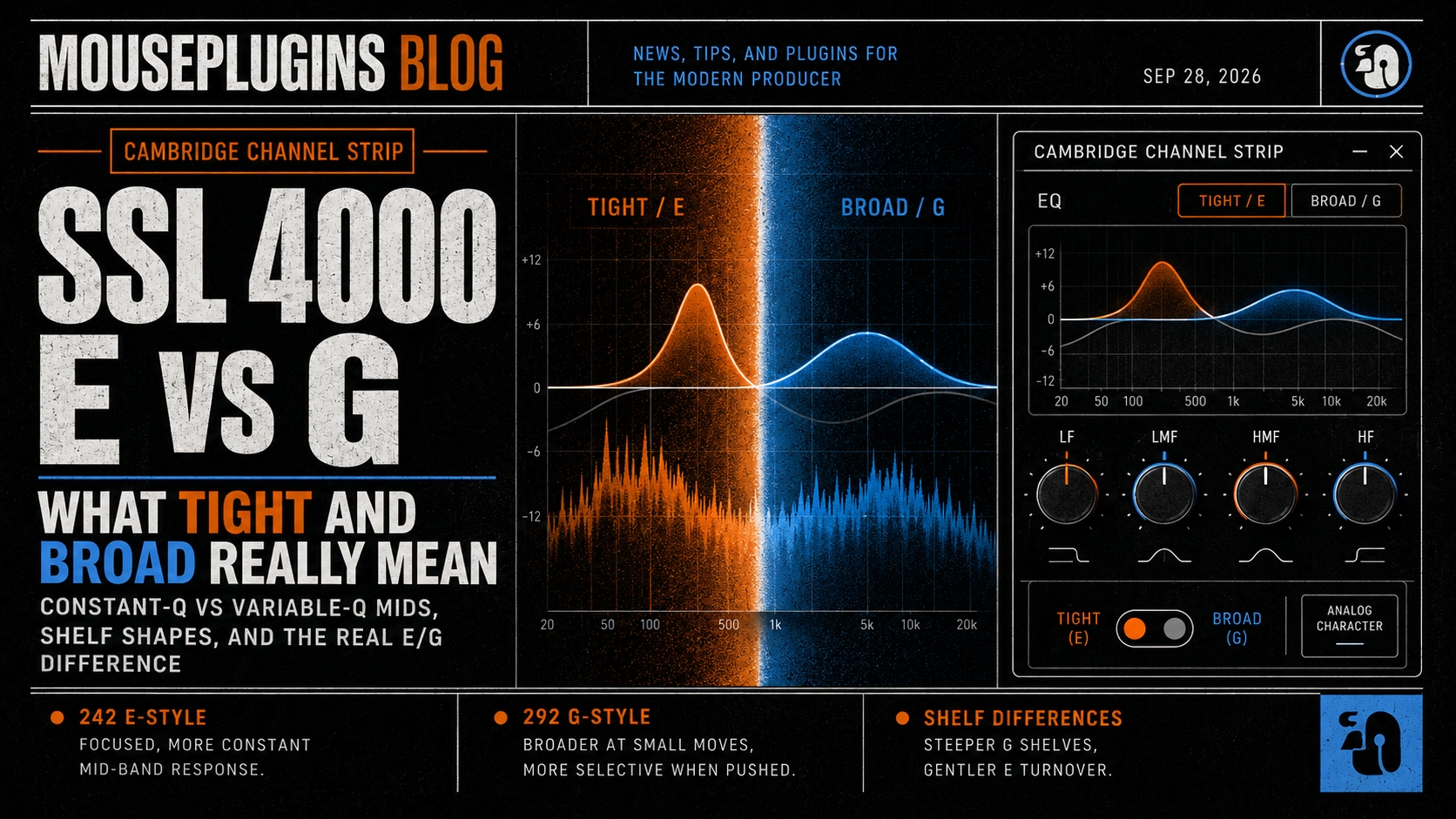
On the 242 E-style EQ, the mid-band bandwidth stays approximately constant as boost or cut changes. Set a focused Q, make a small move, and the move remains focused. That makes an E-style curve a useful starting point when you want to make a more localised adjustment. Think of this as the TIGHT end of the comparison—especially at modest gain settings.
On the 292 G-style EQ, bandwidth interacts with gain. Small boosts or cuts produce BROAD bell curves; push the gain or cut further and the response becomes more selective. A gentle tonal lift can therefore spread over a wider area, while a stronger move becomes more focused. The Q control still matters: “BROAD” does not mean that every G setting is wide. Source: SSL Channel Strip 2 User Guide
This is the subtle point behind the names. TIGHT and BROAD describe how the EQ responses compare at a given setting, not a permanent property of every sound made on either console. SSL also characterises the complete G console as tighter and more refined than the E. That is not a contradiction: a console's overall character and the width of a small mid-band EQ move are different things. Source: SSL Channel Strip Guide
2. The shelves have a different contour
The E-style high and low shelves are comparatively conventional and gentler around their turnover frequencies. G-style shelves are steeper and can show a small opposite-direction dip or bump near the turnover—often called undershoot/overshoot. A shelf is therefore not just “more or less treble” or “more or less bass”: its shape can change the sense of edge and weight around the chosen frequency. This is why matching only the displayed frequency and gain is not enough to make E and G sound identical. Sources: SSL Channel Strip 2 User Guide, SSL Super 9000 User Guide
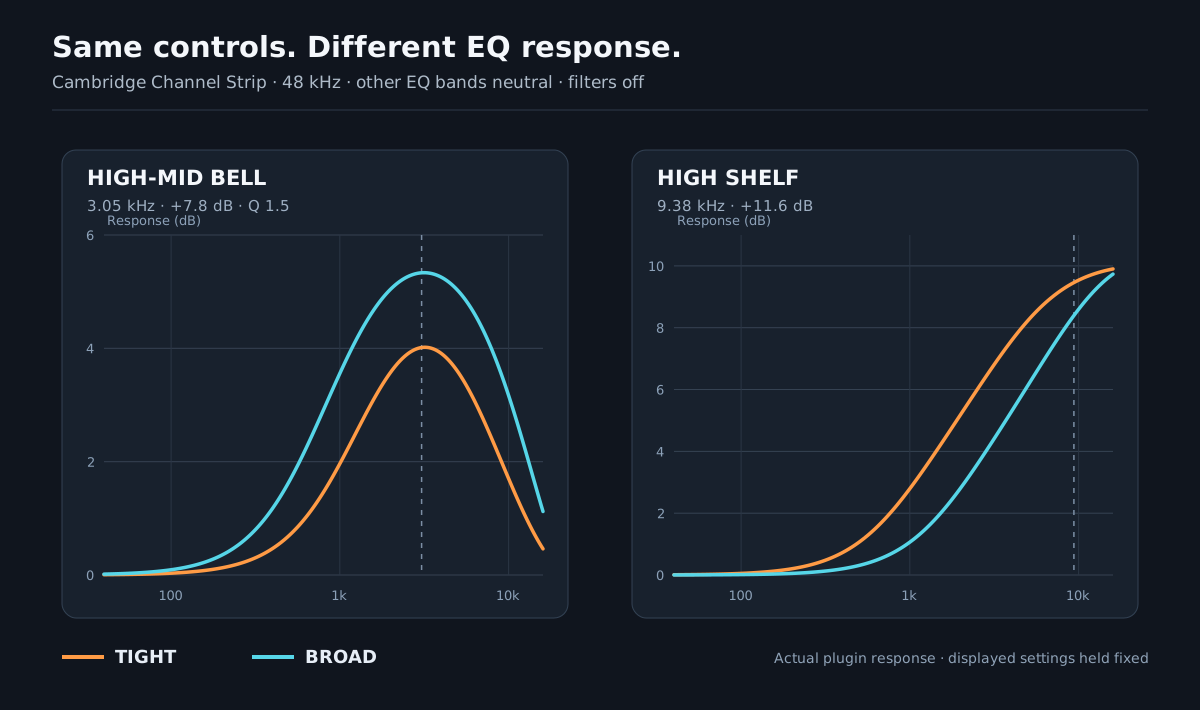
Actual Cambridge Channel Strip EQ response model at 48 kHz. Within each panel, frequency, gain and Q are held fixed; only TIGHT/BROAD changes. The other EQ bands are neutral and the high-/low-pass filters are off. This is a comparison of our plug-in's EQ characters, not a measurement of two physical SSL consoles.
3. The G broadened the range of uses, too
The 4000 G's 292 EQ added LMF ÷3 and HMF ×3 options, extending where the two mid bands can reach. That is a frequency-range feature, not a synonym for a broad Q. It let an engineer place a mid-band bell farther into low or high territory while retaining the familiar four-band channel layout. Source: SSL Channel Strip Guide
| At comparable settings | E-style 242 EQ | G-style 292 EQ |
|---|---|---|
| Modest mid-band boost/cut | More consistently focused; bandwidth stays roughly constant | Broader, gentler contour |
| Larger mid-band boost/cut | Still governed by the selected Q | Becomes more selective as gain increases |
| High/low shelves | Gentler, more conventional turnover | Steeper contour with possible undershoot/overshoot |
| Practical starting point | Focused shaping, drums, attack or corrective moves | Shape overall tone with a small move |
These are starting points, not rules about which mode is “better.” Frequency, gain, Q, source material and level all matter more than a label.
Beyond EQ: E and G were different consoles
SSL describes the 4000 E as punchy and comparatively aggressive. Its channel strip changed during production: E EQs evolved from Brown Knob to Black Knob, and the channel dynamics also went through revisions. It is inaccurate to imagine one frozen “E circuit” shared by every desk. Source: SSL Channel Strip Guide
For the 4000 G, SSL identifies a redesigned mic preamp aimed at cleaner amplification and more headroom, revised channel dynamics with a tighter and more refined compression character, the new Pink Knob EQ, and an improved automation workflow. Those changes explain why an E/G console comparison cannot be reduced to an EQ graph alone. They also explain why an EQ-mode switch in a modern channel strip should not be mistaken for a switch that silently replaces its preamp, compressor, VCA and automation system. Source: SSL Channel Strip Guide
What TIGHT and BROAD mean on our channel strip
On Cambridge Channel Strip, TIGHT and BROAD name the two selectable EQ response characters. TIGHT is the E-style choice; BROAD is the G-style choice. They are independently calibrated responses, so identical displayed frequency, gain and Q values need not trace the same curve. The selector changes the EQ response character; it does not switch the entire plug-in to another historical console model. Our labels are a practical way to choose and compare EQ behaviour, not a claim that two complete SSL desks—or every revision of them—are reproduced by one button.
A useful test is simple: set a modest low-mid boost, keep frequency, gain and Q fixed, then toggle TIGHT/BROAD while watching the EQ chart and listening in context. Repeat with a stronger move and with a high or low shelf. The small mid-band move usually makes the bandwidth distinction easiest to understand; the shelf makes the contour distinction easier to see. Use whichever curve serves the track, then make the final decision in the mix rather than from the button name.
The short version
The E and G are generations of SSL's 4000 console, with differences across the channel—not just the EQ. For their classic 242 E versus 292 G EQ comparison, the E mids maintain a more constant, focused bandwidth, while the G mids start broader at small gain moves and tighten as the move grows. G-style shelves also have a steeper, more shaped turnover. On our channel strip, TIGHT/BROAD is the invitation to hear those two EQ characters side by side; it is not a claim that one switch changes the entire console.
Further reading
SSL and Solid State Logic are registered trademarks of Solid State Logic. MousePlugins is not affiliated with or endorsed by Solid State Logic. Product names are used solely for identification and technical comparison.