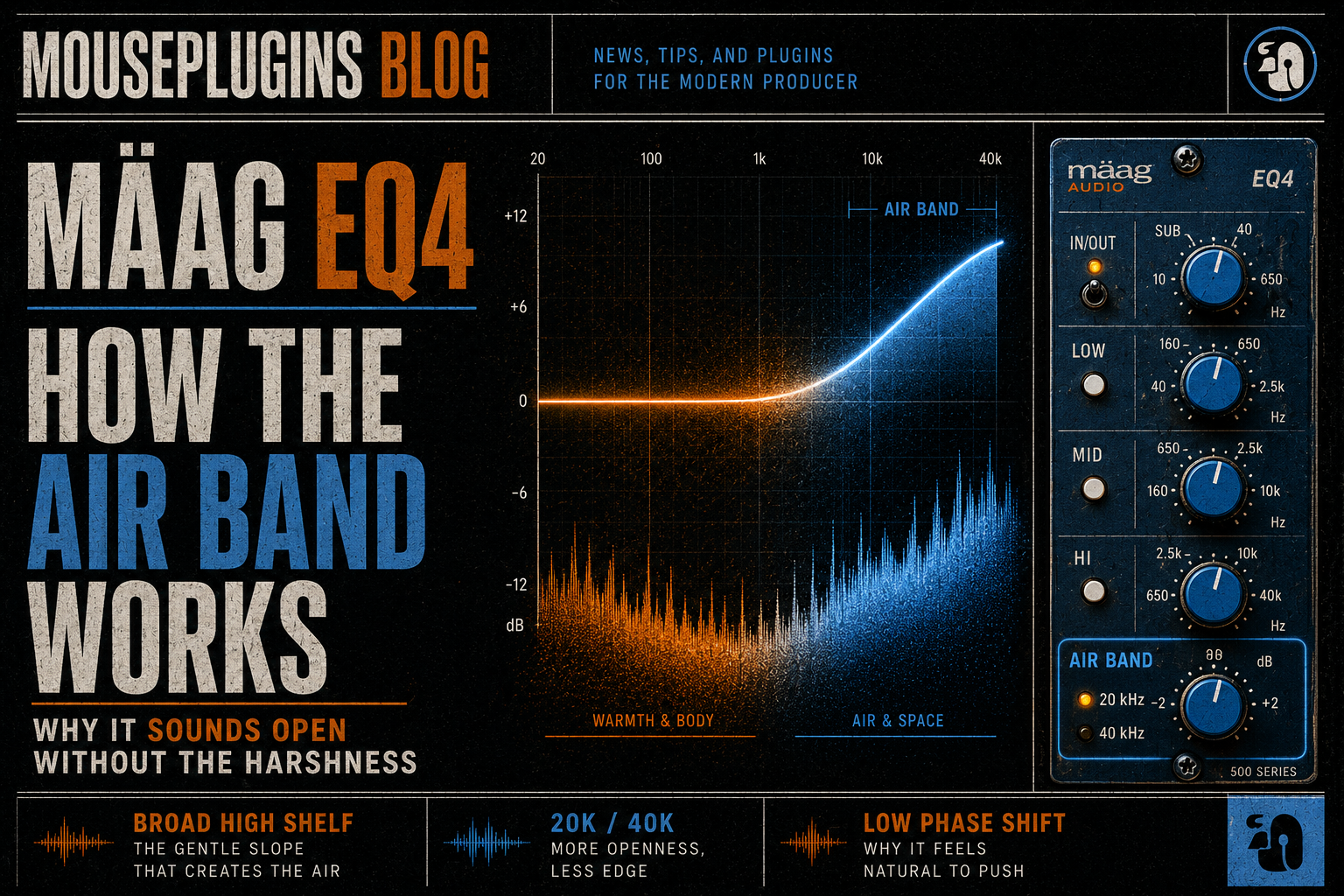
The Mäag EQ4 is best known for one control: the AIR BAND®. On suitable material, it can add brightness and openness without emphasizing sibilance as quickly as a lower-frequency high shelf might.
There is no need for ultrasonic mysticism. Selecting 40 kHz does not mean that the listener must hear a 40 kHz tone. The ordinary audible explanation is the broad transition of the shelving filter below its nominal setting.
In one line: at the higher AIR BAND settings, much of the shelf transition lies near or above the audible range, so the part remaining below 20 kHz is a relatively gentle rise.
This article focuses mainly on the classic single-channel EQ4-500 control set. Later hardware revisions and related models do not all have identical controls.
What the EQ4 is
The classic EQ4-500 is a single-channel, six-band analogue equalizer for the 500-series format. Five controls provide fixed-frequency tone shaping, while the AIR BAND is a boost-only shelf with a selectable frequency.
Its bands are:
- Sub, nominally 10 Hz: fixed bell, boost or cut
- 40 Hz: fixed bell, boost or cut
- 160 Hz: fixed bell, boost or cut
- 650 Hz: fixed bell, boost or cut
- 2.5 kHz: fixed shelf, boost or cut
- AIR BAND: boost-only shelf selectable at Off, 2.5, 5, 10, 20, or 40 kHz
According to Mäag’s EQ4-500 manual, the five main bands provide up to +15 dB of boost and −4.5 dB of cut. The AIR BAND provides up to +20 dB. The AIR GAIN control is a 21-position potentiometer.
The appeal is not surgical flexibility. Nothing is sweepable, and there is no variable Q. The EQ4 provides a small set of broad, deliberately chosen curves and expects the engineer to work with them.
What the AIR BAND actually does
The AIR BAND is a broad, boost-only high-frequency shelving filter.
Its frequency selector should not be treated as a brick-wall boundary, or necessarily as the exact point where the filter first acts or reaches its final gain. Terms such as shelf frequency, turnover frequency, corner frequency, and centre frequency are not always used in exactly the same way by circuit designers, manufacturers, measurement software, and plugin developers.
What matters here is the measured or implemented response, not an overly literal reading of the number printed on the panel.
Mäag’s manual explicitly notes that frequencies below the selected shelf setting are affected by the filter’s transitional slope. At the 20 and 40 kHz positions, part of that transition remains inside the audible band even though the nominal setting is near or above its conventional upper limit.
You therefore hear a gradual lift below the selected frequency, not a newly audible 40 kHz component.
At a fixed AIR GAIN position, the 40 kHz setting applies less gain through most of the audible treble than the 5 or 10 kHz settings. The audible frequencies sit farther down the transition rather than near the upper part of the shelf.
That distinction is essential: the AIR GAIN knob position is not the amount of boost applied equally at every audible frequency.
Why it can sound smoother than a lower shelf
A shelf placed around 5 to 10 kHz can apply substantial gain directly to sibilance, cymbal energy, microphone edge, and other upper-treble content. Depending on the source and the amount of boost, that can become sharp or tiring.
With the AIR BAND at 20 or 40 kHz, the audible part of the response is generally a shallower rise. It can lift the extreme top end while applying less gain farther down.
That does not make the filter incapable of sounding harsh. A harsh recording remains harsh, and enough boost can make almost anything unpleasant. The AIR BAND simply provides a useful way to distribute the boost more gradually.
The lower positions have a different character:
- 2.5 and 5 kHz reach well into the presence region and can sound forward or aggressive.
- 10 kHz behaves more like a familiar upper-treble lift.
- 20 and 40 kHz move more of the transition upward, leaving a gentler rise across most of the audible band.
The result depends on the source, gain setting, monitoring chain, and listener. “Air” is a useful engineering description, not a separate category of physics.
Why this article does not publish invented response figures
It is easy to draw an illustrative high shelf and calculate a table of values. It is also easy to give that model an arbitrary definition of “shelf frequency,” an arbitrary transition shape, and no demonstrated relationship to the actual EQ4 circuit.
A statement such as “a first-order shelf set to 40 kHz gives exactly x dB at 10 kHz” is meaningless unless the transfer function, gain normalization, and frequency convention are all defined. Even then, the numbers describe the model, not necessarily the hardware.
The robust claim is qualitative and testable:
For the same AIR GAIN setting, moving the AIR BAND selector upward shifts the broad transition upward and reduces the boost applied through most of the audible treble.
Hardware measurements or a carefully documented plugin analysis can put exact figures on a particular unit or emulation. A generic shelf model cannot establish those figures for every EQ4.
Can another EQ reproduce it?
A sufficiently flexible equalizer can approximate the AIR BAND’s magnitude response. There is no law of electronics reserving broad high shelves for one manufacturer.
For ordinary minimum-phase filters, a close magnitude-response match also implies a correspondingly close phase response. Phase should therefore not be presented as an independent mystery ingredient after the magnitude curve has been matched accurately.
Differences may still remain because of:
- imperfect matching of the shelf shape
- the control’s gain law and frequency calibration
- interaction with the five other bands
- noise, headroom, and any nonlinear behaviour
- component tolerances between analogue units
- differences between particular software emulations
The defensible claim is not that the AIR BAND is impossible to recreate. It is that the EQ4 packages a useful family of broad curves into a fast, repeatable layout, together with the interaction and operating behaviour of the original design.
About the phase-shift claim
Mäag’s wording has not always been perfectly consistent — even within a single document. The classic EQ4-500 manual describes the EQ adjustments as obtained with “minimal phase shift” and states that “phase shift is very minimal,” yet a few lines later the same manual refers to “the lack of phase shift.” Some promotional material has gone further and used the phrase “no phase-shift.”
The qualified wording is the defensible one.
An ordinary causal analogue equalizer built from minimum-phase filter sections cannot alter its magnitude response while leaving phase completely unchanged. The relevant questions are how much phase rotation occurs, over which frequencies, compared with what alternative, and whether the difference matters in use.
It is therefore reasonable to describe low phase shift as a design goal or manufacturer claim. It is not reasonable to describe the EQ4 as a zero-phase equalizer, or to claim that phase behaviour alone proves why listeners perceive its top end as smooth.
The bands interact, and level matching matters
The EQ4 manual states that its bands interact and that increasing AIR BAND gain can also raise the overall signal level, by as much as roughly 4 dB at the extreme.
For the classic EQ4-500, Mäag recommends compensating by turning down each of the five main band controls by the same amount. The manual gives “two clicks down on all five knobs” as an example and states that the EQ shape is retained while the overall level is reduced.
That is a characteristic of this design, not a universal EQ technique.
It is also not a substitute for careful level matching. A slightly louder signal is often preferred in a quick comparison because it can seem more vivid, detailed, or substantial. Human frequency sensitivity is also level-dependent, so a level difference can alter perceived tonal balance as well as perceived loudness.
Some plugin versions provide a dedicated level-trim control. The EQ4M hardware instead provides an input attenuator (0 to −10 dB) for compensation.
Where the AIR BAND came from
The AIR BAND concept predates Mäag Audio.
Cliff Mäag Sr. has described learning the sound of an open vocal chain from an original C12 microphone, a Boulder preamp, and an LA-2A. His custom console could not produce the same result with every microphone, particularly sources that he found difficult to “open up,” so he developed new microphone-preamplifier and high-frequency EQ circuitry.
According to Mäag, the process began in the microphone preamp and was later expanded into multiple selectable bands before being incorporated into an equalizer.
The AIR BAND appeared commercially in the NTI EQ3 in 1993 and later returned in products released under the Mäag Audio name.
It is therefore more accurate to say that the commercial EQ feature grew out of earlier custom-console and microphone-preamp work than to say it was conceived from scratch inside the EQ3.
The related models are not identical
The AIR BAND name appears across several Mäag products, but their controls and gain ranges are not interchangeable.
- The classic EQ4-500 provides Off, 2.5, 5, 10, 20, and 40 kHz positions, with up to +20 dB of AIR GAIN.
- The EQ4M is a dual-channel rackmount mastering model. It adds a 15 kHz AIR BAND position, an input attenuator (0 to −10 dB), and provides up to +15 dB of AIR gain.
- Mäag’s current product page for the updated EQ4-500-BK also lists a 15 kHz position, although the downloadable 2023 EQ4-500-BK manual still depicts the earlier selector without it. Anyone documenting a specific unit should check its actual panel and revision.
- Officially licensed plugin versions add their own workflow controls, such as output trim, and newer variants are not necessarily exact control-for-control copies of the original EQ4-500.
The shared AIR BAND name describes a design family, not one immutable transfer function across every product and revision.
Four claims this article is not making
-
The audible result requires direct hearing at 40 kHz.
The ordinary explanation is the part of the filter transition that remains below it. -
The AIR BAND creates a new substance called “air.”
Its intended EQ action changes the amplitude and phase of spectral content already in the signal. Any harmonic generation is incidental, not the basic mechanism. -
No other equalizer can produce a similar curve.
A sufficiently flexible EQ can approximate it. -
The EQ4 has zero phase shift.
The manual’s defensible claim is minimal phase shift, not none.
How it tends to get used
None of the technical explanation prescribes a workflow, but several uses are common:
- Vocals: moderate lift at 10, 20, or 40 kHz for openness, with less presence-region boost than the lower selector positions.
- Overheads and cymbals: higher positions can add upper-treble lift without emphasizing the lower treble as strongly.
- Mix bus: small amounts at 20 or 40 kHz can produce a broad upward tilt at the top.
- Dark sources: the 2.5 and 5 kHz positions reach into the presence region and can bring a source forward.
Two practical habits help: begin with a higher-frequency position and move downward only when more presence is needed, and level-match before deciding whether the change is genuinely better.
The practical point
The EQ4 is not a surgical equalizer. Its value is speed, broad tone shaping, and a distinctive set of fixed controls.
At the higher AIR BAND settings, much of the shelf transition lies near or beyond the upper end of the audible range. The portion that remains below it can provide a gradual upper-treble lift that often sounds less aggressive than applying a comparable control setting at a lower shelf frequency.
That is the useful explanation. No bats, no ultrasonic magic, and no requirement to pretend that ordinary filter theory stopped working when someone installed a blue knob.