Same box. Same distortion valve. Three switch positions. Yet T, P1 and P2 can behave like three quite different effects. Why?
On Thermionic Culture's original three-position Culture Vulture, the type switch changes how its 6AS6 distortion valve operates. Drive decides how much signal reaches that stage; Bias changes its operating point. Type therefore does more than move a generic “saturation amount” knob. The combination changes which harmonics develop, when they develop, and how strongly the output responds to the incoming level. Source: Thermionic Culture's original operating manual
The useful shortcut: T is the cleaner triode starting point; P1 is the more assertive pentode voice; the original P2 is the unusual alternative pentode setting where Bias and level can lead to much more drastic behaviour. These are tendencies, not three fixed harmonic recipes.
First, which Culture Vulture?
This article means the original three-position T/P1/P2 unit. That qualifier matters. The later 20th Anniversary CV20A has four positions. Thermionic Culture describes its new P2 as an over-compression effect and relabels the original P2 as P3. If you have read two apparently contradictory descriptions of P2, you may have been reading about two different hardware editions. Source: Thermionic Culture's CV20A product sheet
DeepFryer has T, P1 and P2 modes. The hardware history below is context; the later plots show DeepFryer's actual plug-in output, not measurements of a physical Culture Vulture or a claim that every hardware revision is interchangeable.
T: the smoother starting point
T connects the distortion valve in a triode configuration. Thermionic Culture calls it the cleanest of the original three settings and associates it with gentler thickening rather than immediate aggression. At restrained levels, the familiar shorthand is an even-harmonic tendency: added second harmonic can make a tone feel fuller without requiring a large amount of obvious fuzz. Source: original operating manual
That is a starting point, not a promise that T produces only even harmonics. Push Drive, move Bias, and the entire signal path becomes relevant. The third harmonic can become significant too. “Triode” describes the valve configuration, not a guarantee that a spectrum analyser will show H2 above H3 at every setting.
Try T when: you want to start with restrained density, transient rounding or gentle thickening, then increase Drive only as far as the source needs.
P1: the bite
P1 uses a pentode configuration. The original manual associates this setting with odd-harmonic behaviour and a more assertive character than T. A stronger third harmonic can make an edge or attack stand out even when the fundamental stays in place. Source: original operating manual
Again, “odd-harmonic” does not mean “odd harmonics only.” Bias, input level and the rest of the circuit can introduce even-order content. Nor is P1 automatically better for every drum or guitar. It is simply a different operating regime that tends to make its colour known sooner.
Try P1 when: T gives you the right density but not quite enough articulation, grit or forwardness.
P2: the original wild card
The original P2 is an alternative pentode configuration. Thermionic Culture's manual warns that it can become much more drastic at higher Bias settings, especially with Overdrive engaged. It also describes a frequency-doubling effect at particular Bias and signal-level combinations—not a permanent extra octave that appears whenever P2 is selected. Source: original operating manual
That distinction is worth keeping. The later CV20A's new P2 is the setting the maker specifically describes as relatively clean until overload, followed by sudden harmonics and over-compression. On that four-position unit, the old P2 behaviour is called P3. The two descriptions should not be blended into one universal “P2 curve.” Source: Thermionic Culture's CV20 operating manual
Try the original P2 idea when: you want unusual level-sensitive breakup, more drastic distortion and the possibility of frequency-doubling effects as Bias and level interact. Adjust Bias and incoming level deliberately, not just the Type switch.
| On the original unit | T | P1 | P2 |
|---|---|---|---|
| Valve configuration | Triode | Pentode | Alternative pentode |
| Useful starting description | Cleaner and gentler | More assertive, often odd-harmonic-led | More level- and Bias-sensitive; can become drastic |
| Important caveat | Not “even harmonics only” | Not “odd harmonics only” | Not the newer CV20A's P2 setting |
What does this look like in DeepFryer?
Rather than draw a hypothetical Culture Vulture curve, we rendered an actual DeepFryer 2.0.0-rc2 Linux CLAP build through its three modes. The DSP in this measured build was frozen for the 2.0.0 release. These plots measure DeepFryer, not a physical Culture Vulture.
For the comparison, the signal and every control other than Type were held fixed: 1 kHz sine; Drive 50%; Bias 0.10 on DeepFryer's normalised 0–1 scale; Design 2× quality; Overdrive off; filters off; Tilt neutral; Mix 100%; Auto Gain off; unity manual input/output gain. The stereo lanes were linked, and the analysis used a 48 kHz, 128-sample block render after warm-up. DeepFryer's normalised Bias value is not the hardware's valve-current reading in milliamps.
1. The waveform relationship changes
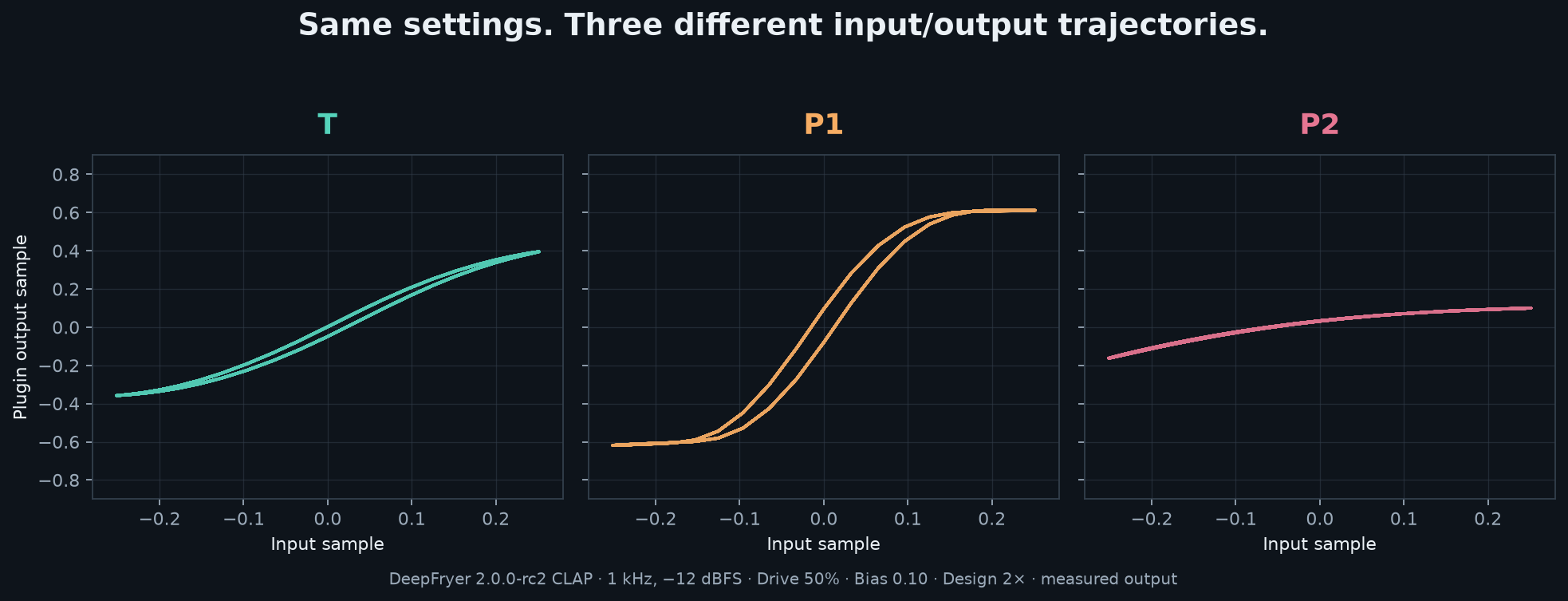
Actual DeepFryer input/output trajectories for a −12 dBFS, 1 kHz input. The plug-in's reported 64-sample latency is aligned. These loops include its dynamic and phase behaviour: they are not a claim to have extracted a memoryless valve transfer function.
At this setting, T bends the sine more gently; P1 drives it toward a broad plateau; P2 produces a lower-output, more asymmetric shape. The shared axes are intentional: the different output level is part of the result when the controls really are held equal. For a listening comparison, level-match after switching modes so loudness does not make the decision for you.
2. The harmonics are not the same mix
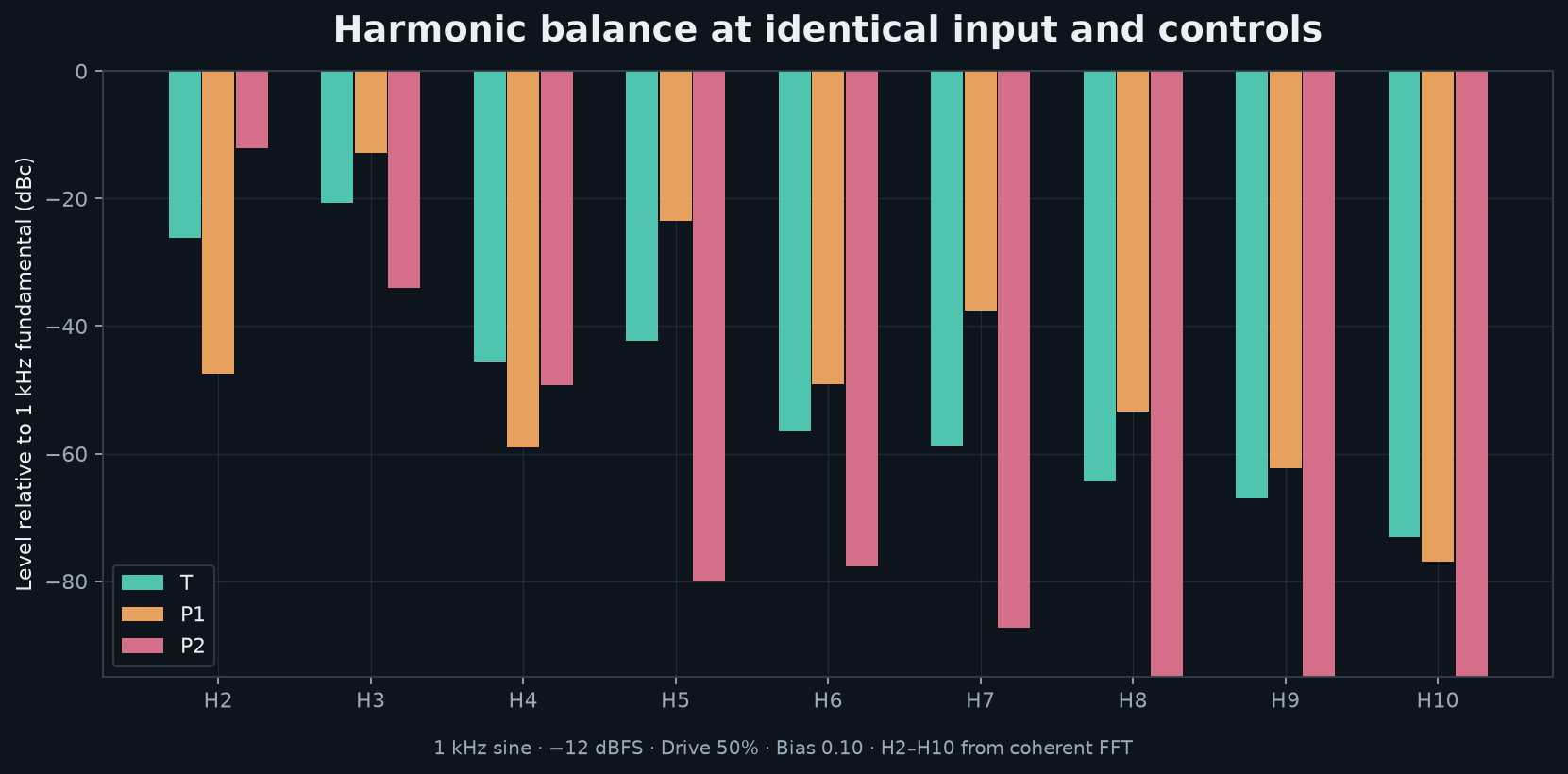
Harmonic levels in dBc, each relative to that mode's own 1 kHz output fundamental. A taller bar means a stronger harmonic relative to that fundamental, not necessarily a louder absolute output. No physical hardware was measured.
At this one coordinate, P1's third harmonic is −12.8 dBc, while its second is −47.5 dBc: a clear odd-order emphasis. P2 almost reverses that balance, with H2 at −12.1 dBc and H3 at −34.0 dBc. T is less extreme overall, though its H3 (−20.6 dBc) is above its H2 (−26.2 dBc) here. That last result is a useful warning against treating “triode = only even harmonics” as a law.
P2's strong H2 at this plug-in setting is not proof that the hardware always produces an audible octave. It is evidence of what this DeepFryer build did with this test tone and these controls.
3. Level changes the story again
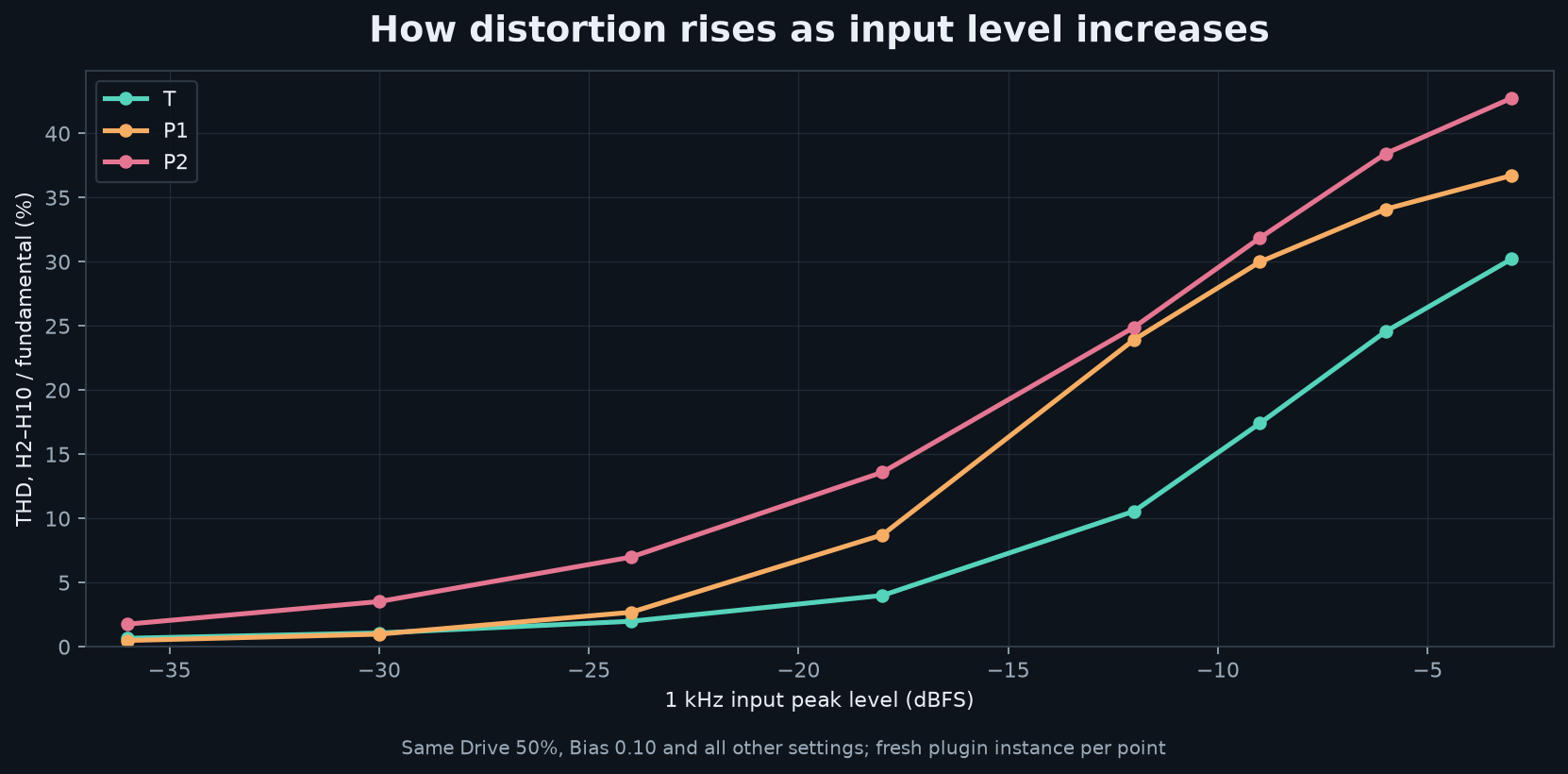
H2–H10 THD is the RMS sum of those harmonics divided by the fundamental. Each input-level point uses a fresh plug-in instance; it is a ratio, not a sound-quality score.
With Drive and Bias unchanged, increasing the input from −36 to −3 dBFS takes measured H2–H10 THD from 0.7% to 30.2% in T, 0.5% to 36.7% in P1 and 1.8% to 42.7% in P2. The gap between modes is not a fixed offset: the input level changes how quickly each response develops. At −12 dBFS, the measured values are 10.6%, 23.9% and 24.9% respectively.
These numbers are descriptive, not a ranking of which mode “sounds best.” The three modes also have different output fundamentals at the same settings. Use the plots to understand what is changing, then compare them at matched loudness in the track.
A useful listening test
Start in DeepFryer's full-range, linked stereo path. Turn Auto Gain off, keep Mix fully wet, Overdrive off, filters off and Tilt neutral. Use the same loop, Drive and Bias while switching T → P1 → P2. Bring the resulting output to a comparable listening level after each switch. Then keep Type fixed and move Bias and incoming level separately. You will hear why a mode label alone cannot describe the complete sound.
The short version
On the original three-position Culture Vulture, T changes the valve to triode operation and is the cleaner starting point; P1 uses a more assertive pentode configuration; P2 is the alternative pentode setting whose behaviour can become far more unusual as Bias and level change. Later four-position hardware uses P2 for a new over-compression mode and calls the original P2 P3. Sources: original operating manual, CV20A product sheet
DeepFryer's T/P1/P2 control is a practical way to hear three different distortion behaviours. The measurements above show its own output at one controlled setting—not a graph of a hardware unit and not a claim that one switch recreates every Culture Vulture revision. What changes is not just the amount of distortion, but how it develops.
Sources and measurement notes
- Thermionic Culture: original Culture Vulture operating manual (2005; archived manufacturer PDF)
- Thermionic Culture: Culture Vulture CV20A product sheet (archived manufacturer PDF)
- Thermionic Culture: Culture Vulture CV20 operating manual, issue 2 (archived manufacturer PDF)
- DeepFryer measurement build: 2.0.0-rc2 Linux CLAP (DSP frozen for 2.0.0), SHA-256
15fc8bce8a5f87c40f7f0c39e93c71f59df6a6a1c1b191152b853cf25209552b. Settings and analysis method are described above.
MousePlugins is not affiliated with or endorsed by Thermionic Culture. Culture Vulture is named solely to identify and discuss the hardware.