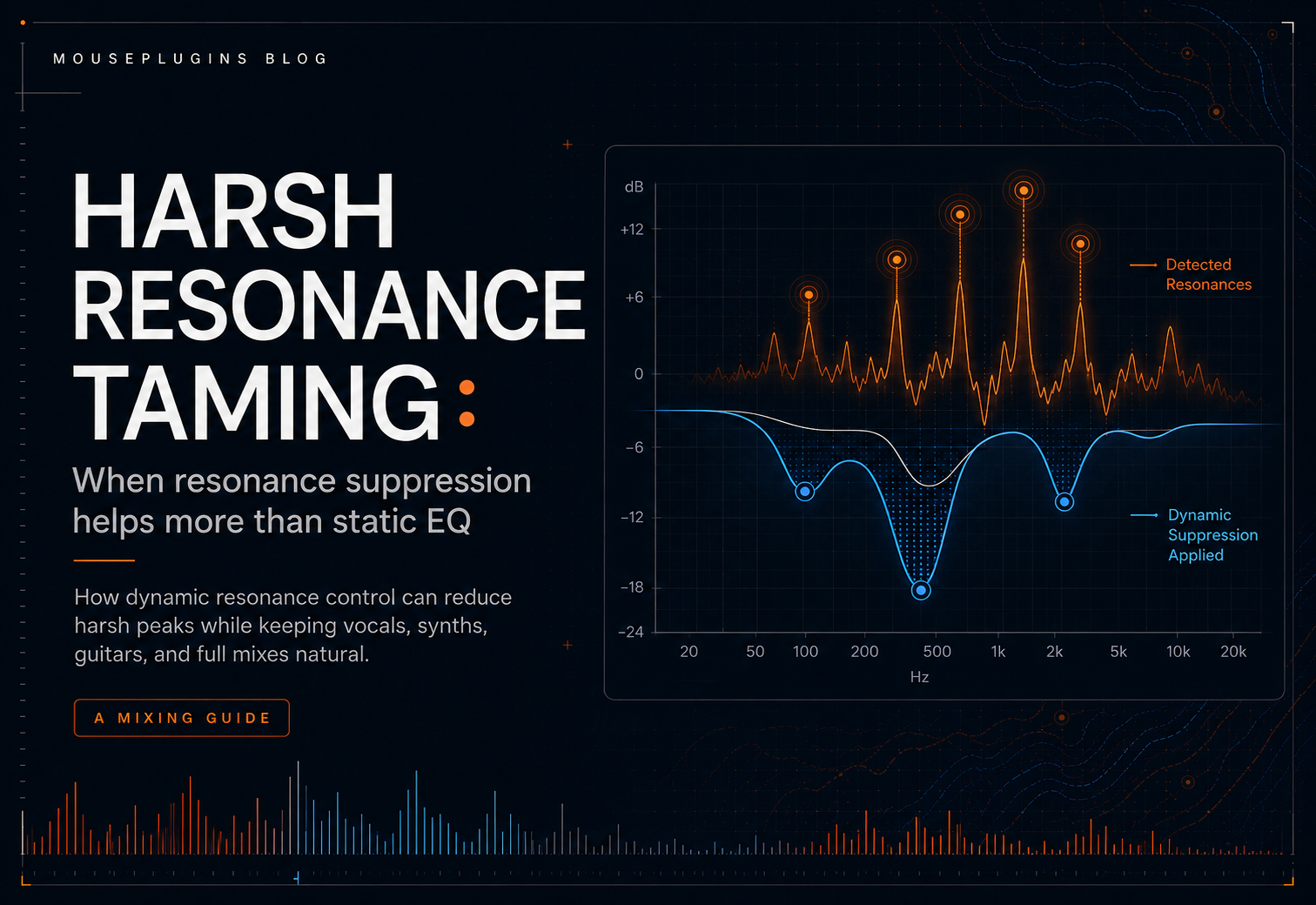
Harsh Resonance Taming: When Resonance Suppression Helps More Than Static EQ
Every mix has moments where something feels sharp, nasal, boxy, metallic, or painfully forward. A vocal might stab around 3–5 kHz. A guitar might ring in the upper mids. A synth might have a whistling peak that only appears on certain notes. A drum room might build up low-mid mud every time the kick and toms hit together.
The old solution was simple: grab an EQ, sweep for the ugly frequency, and cut it.
That still works — sometimes. But harsh resonances are often dynamic. They appear, disappear, move, and change level depending on the performance. A static EQ cut can solve the worst moment while making the rest of the track dull, thin, or lifeless.
That is where resonance suppression can help.
What is a resonance?
A resonance is a frequency area that rings or builds up more than the surrounding tone. It can come from the instrument, the room, the microphone, the speaker, distortion, compression, or even the arrangement.
Not all resonance is bad. Resonance is part of what gives instruments character. A cello body resonates. A snare shell resonates. A vocal tract resonates. Remove too much and the source stops sounding natural.
The problem is uncontrolled resonance: narrow frequency peaks that distract from the performance or make the mix feel uncomfortable.
These ranges are rough starting points, not rules. The right frequency depends on the source, arrangement, microphone, processing, and performance.
Common examples:
- Vocal harshness around 2–6 kHz
- Nasal tones around 700 Hz–1.5 kHz
- Boxiness around 200–600 Hz
- Metallic cymbal spikes in the high mids
- Piercing guitar or synth harmonics
- Low-mid buildup on buses
- Master bus harshness after limiting
Resonance suppression vs EQ
A conventional EQ cut is static. If you cut 4 kHz by 3 dB, it cuts 4 kHz all the time.
A dynamic EQ improves on that by cutting only when a selected band crosses a threshold. But you still usually choose the band yourself.
A resonance suppressor takes a different approach. It listens for resonant peaks across a wider frequency range and reduces the specific problem areas dynamically. Instead of manually placing every notch, the processor follows the signal in real time.
In many cases, the most natural result does not sound like “EQ being automated.” It simply feels like the unpleasant peaks have calmed down while the original tone remains intact.
soothe3 as a familiar example
oeksound’s soothe3 is a well-known example of this category. The official manual describes it as a dynamic resonance suppressor that detects resonant peaks and reduces them with real-time dynamic filtering. It can be used on individual tracks, buses, or even the master bus for focused resonance control.
soothe3 is mentioned here only as a familiar third-party example of the category; MousePlugins is not affiliated with oeksound.
The important idea is not “use soothe on everything.” The important idea is the workflow: listen for harshness, focus the processing, use just enough suppression to reduce the problem, then back off before the source loses life.
The danger: over-suppression
Resonance suppression is powerful, but it is easy to overdo.
If you push too hard, the result can become:
- Dull
- Phasey
- Hollow
- Lifeless
- Over-controlled
- Detached from the performance
A resonance suppressor should usually remove irritation, not personality.
A good test is this: when you bypass the processor, the original should sound obviously more annoying. But when the processor is active, you should not immediately think “I hear a plugin working.”
Practical workflow for taming harshness
A simple approach:
-
Identify the problem
Is it harshness, boxiness, ringing, mud, or sibilance? Does it happen all the time or only on certain notes? -
Start broad
Do not immediately chase tiny notches. First decide the region: lows, low-mids, mids, upper mids, or highs. -
Use delta/monitoring if available
Many resonance suppressors let you hear what is being removed. If the removed signal sounds like the whole instrument, you are probably doing too much. If it sounds like mostly whistles, rings, harsh edges, or mud, you are closer. -
Set the amount conservatively
Increase suppression until the problem clearly improves. Then reduce it slightly. -
Check in the mix
Solo can lie. A resonance that sounds ugly in solo may help the part cut through the arrangement. The final decision should be made in context. -
Bypass often
Level-match if possible. Make sure you improved the mix, not just made it quieter or smoother.
Where resonance suppression works well
Resonance suppression can be especially useful on:
- Vocals: harsh syllables, nasal notes, mic/room peaks
- Acoustic guitars: pick attack, body boom, string squeak harshness
- Electric guitars: fizzy distortion, upper-mid spikes
- Drums: ringy snares, harsh cymbals, boxy rooms
- Synths: sharp filter peaks, digital whistles, resonant layers
- Buses: accumulated harshness from many tracks
- Masters: small resonance control before or after compression/limiting
When not to use it
Do not reach for resonance suppression automatically.
Sometimes the better fix is:
- Better gain staging
- Less compression
- A different distortion setting
- Mic placement
- Arrangement changes
- Static EQ
- De-essing
- Volume automation
Resonance suppression is not a replacement for mixing judgment. It is a precision tool.
Final thought
Harshness is rarely just “too much high end.” It is often uneven energy: small peaks that jump out, fatigue the listener, and make the mix feel more fatiguing, less focused, or less polished.
The best resonance suppression does not make a track sound processed. It makes the listener stop noticing the problem.
Used carefully, tools in this category became popular because they solve a real modern mixing problem. Dense productions, bright vocals, aggressive synths, distorted guitars, and loud masters can all create situations where static EQ alone is slower, heavier-handed, or less transparent than dynamic resonance control.
The goal is not to remove all resonance.
The goal is to keep the emotion — and remove the pain.
Reference: oeksound soothe3 manual