Few compressors have left a bigger fingerprint on recorded music than the dbx 160. Its appeal was simple: it sounded controlled, direct, and usable without turning setup into a small administrative tragedy.
The story starts with David E. Blackmer, who founded dbx in 1971. Blackmer’s work helped push dynamics processing toward circuits that responded to signal energy in a more musically useful way than simple peak detection. Two ideas became central to the dbx identity: true-RMS level detection, which reacts to signal power rather than only instantaneous peaks, and the Blackmer gain cell, a voltage-controlled amplifier designed for decibel-linear gain control.
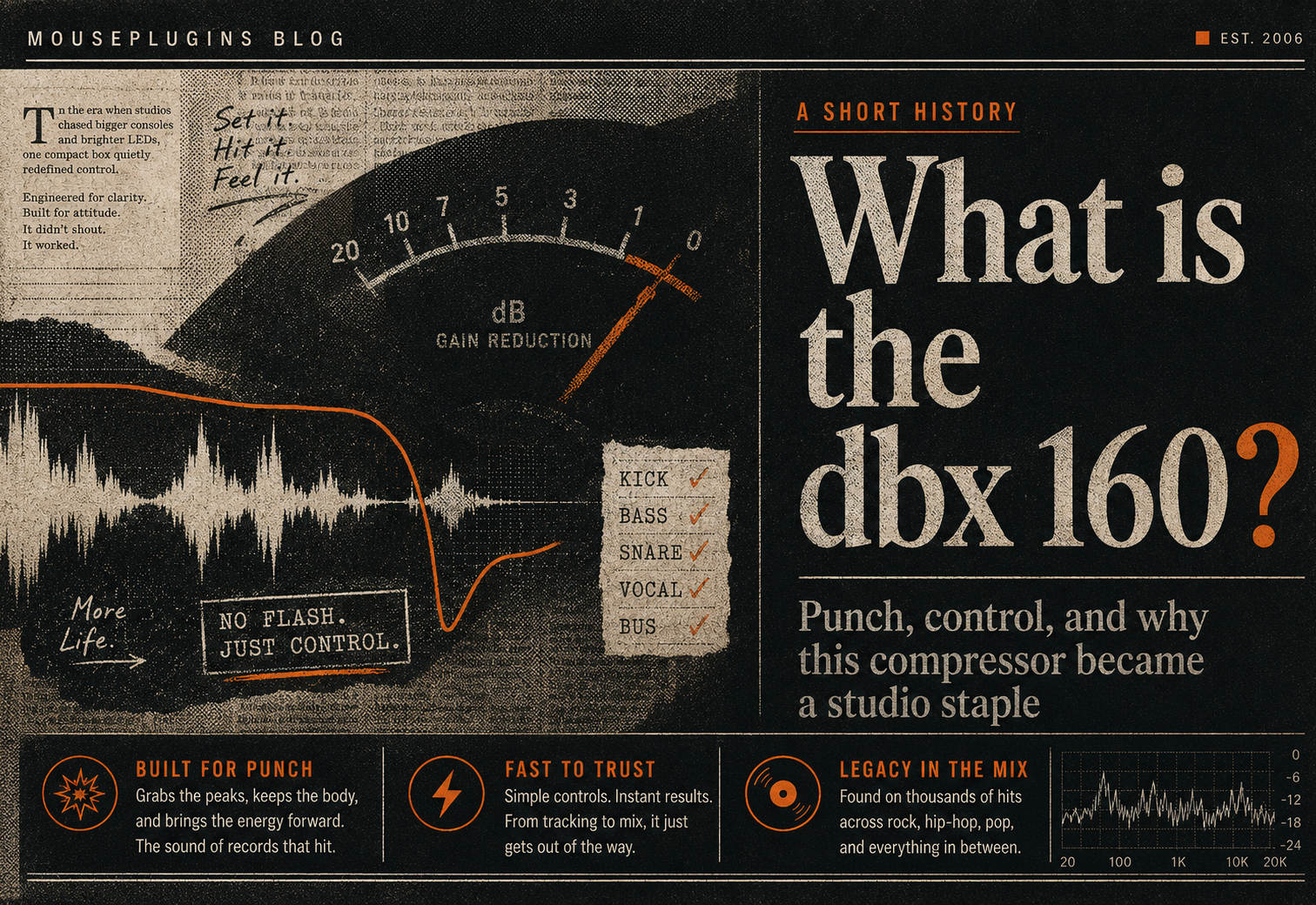
Those ideas found one of their most famous homes in the original dbx 160, introduced in the mid-1970s and often now referred to as the 160 VU. Compared with many studio compressors of its era, the 160 was almost defiantly simple: threshold, compression ratio, and output gain. Engineers could put it on a snare, bass, vocal, or bus and get useful control quickly, without fighting a wall of controls.
The 160 then grew into a wider family. After the original hard-knee 160 came related models such as the 165, 160X, 160XT, and later 160A, plus higher-end designs such as the 160SL. Along the way, dbx also introduced OverEasy compression: a soft-knee behaviour that eases gain reduction in gradually around the threshold. The original 160 is associated with the harder-knee punch, while later family members gave engineers a choice between that firmer response and smoother OverEasy operation.
What did engineers reach for it to do? Mostly: punch. The 160 family became closely associated with drums, especially snare and kick, as well as bass and other sources that need fast control without losing their place in the mix. At higher ratios, later units in the family could also work as practical limiter-style tools for live sound, broadcast, and protection duties.
Blackmer’s ideas did not stop with dbx. He later founded Earthworks Audio and continued pursuing audio design built around measurement, realism, and fast transient response. But the dbx 160 remains the piece of gear many people most immediately connect with his dynamics-processing legacy: technically serious, quick to use, and still respected because it solved a real studio problem.
At MousePlugins, we spend a lot of time studying why classic tools earned their reputations: the circuits, the behaviour, and the feel. Then we build our own compressors and effects with that same respect for behaviour, workflow, and feel, for Windows and Linux.