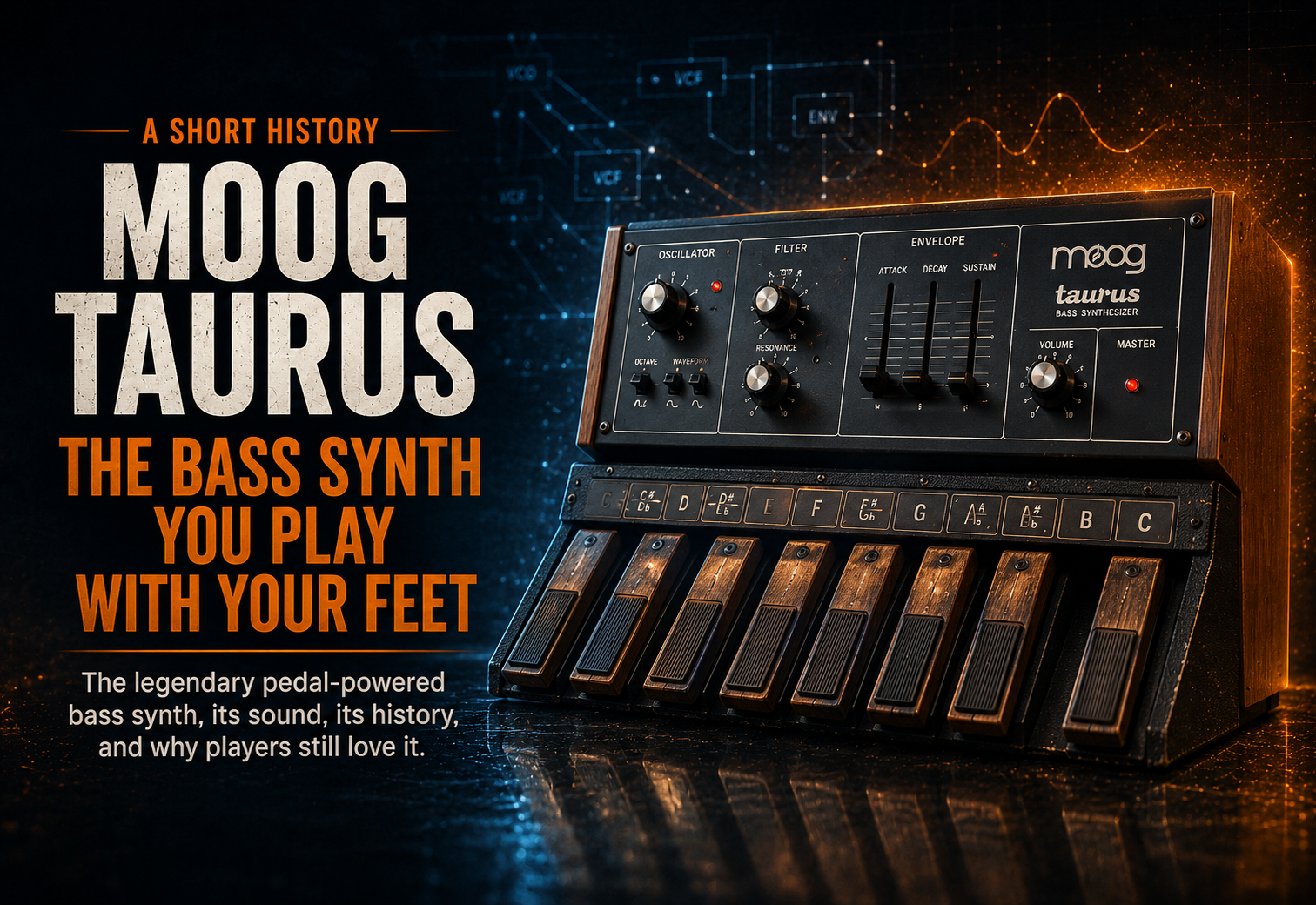
The Moog Taurus is one of the rare synthesizers whose interface is as important as its circuitry. It is not just a bass patch in a different box. It is a monophonic analog synthesizer built into an organ-style pedalboard, designed so a player can trigger low notes with a foot while both hands remain busy elsewhere.
That physical constraint shaped the instrument. The Taurus needed to be immediate, stable, and hard to mis-operate on stage. It needed to produce bass that survived loud guitars, drums, and large rooms. Most of all, it needed to feel less like a keyboard part and more like a structural layer underneath the band.
Bob Moog, Moog Music, and the Voltage-Controlled Instrument
Robert Moog's importance is not only that he helped popularize synthesizers. It is that he helped standardize a practical language for electronic instruments: voltage-controlled oscillators, voltage-controlled filters, voltage-controlled amplifiers, envelope generators, modulation sources, and playable control surfaces.
The early Moog modular systems gave studios access to those building blocks. The Minimoog made them portable and performance-ready. By the 1970s, Moog instruments were no longer laboratory objects; they were part of rock, jazz fusion, film scoring, and experimental music.
The Taurus belongs to that same lineage, but it solves a different performance problem. A keyboard synthesizer assumes the hands are available. The Taurus assumes they are not.
From Constellation to Taurus
The Taurus began inside Moog's larger Constellation concept: a multi-instrument performance system made from three parts.
- Lyra: a monophonic lead synthesizer.
- Apollo: a polyphonic keyboard instrument.
- Taurus: a bass synthesizer controlled by foot pedals.
The full Constellation system never became a normal production product, but its ideas escaped into later instruments. Apollo fed into the Polymoog direction. Taurus survived as a standalone product.
A useful historical correction: the Taurus is naturally associated with Bob Moog because it came from Moog Music and uses the Moog synthesis vocabulary, but the original Taurus I design is widely credited mainly to David Luce, Moog's director of engineering and an important figure in the Polymoog story. Classic instruments are often the result of a company culture rather than one person's hand: Bob Moog's synthesis language, Luce's engineering, musician demand, and 1970s stage realities all meet inside the Taurus.
What the Taurus I Actually Is
The Taurus I is a foot-operated, monophonic analog subtractive synthesizer. The control surface is a 13-note pedalboard rather than a piano keyboard. The player selects and holds notes with the feet, while sound generation happens in the analog voice circuitry.
At a high level, the Taurus I follows the familiar subtractive structure:
- Oscillators generate harmonically rich waveforms.
- A low-pass filter shapes the harmonic content.
- An amplifier and envelope shape the level over time.
- Preset and variable controls define the instrument's stage-ready bass voicings.
The important part is not that this architecture is exotic. It is that the circuit and voicing are narrowly optimized for bass. A generic analog mono synth can play low notes, but the Taurus was designed around low notes as its primary job.
Oscillators, Filter, and Envelope Behavior
The Taurus I is commonly described as a two-oscillator analog bass synth with a resonant low-pass filter and a simple envelope structure. Its famous presets include Taurus, Tuba, and Bass, plus a variable mode for deeper editing.
Technically, the magic is less about one spectacular feature and more about the interaction of several restrained choices:
- Two analog oscillators provide weight, slight movement, and harmonic density.
- Sawtooth-based bass content gives the filter enough upper harmonics to carve.
- A resonant low-pass filter, in the broader Moog analog tradition, gives the sound its rounded but forceful contour.
- Bass-focused gain staging lets the instrument feel large without needing a complex modulation system.
- Simple envelope behavior supports sustained pedal tones rather than flashy keyboard articulation.
The result is a sound that can be thick without being busy. In a mix, the Taurus often behaves like a pressure source more than a melodic synthesizer. It fills the octave below the band and holds it there.
Why It Feels Bigger Than a Normal Synth Bass
A Taurus-style bass note is not just low frequency energy. It is controlled low frequency energy with a strong identity in the low mids. That distinction matters.
A sub sine wave can disappear on smaller speakers. A bright saw bass can fight the guitars. The Taurus sits between those extremes: deep enough to move air, harmonically rich enough to remain audible, and filtered enough to avoid sounding like a lead synth played too low.
The pedal interface reinforces this. Foot playing encourages sustained notes, drones, roots, and slow harmonic movement. Those musical gestures leave room for the Taurus to bloom. It is less suited to fast keyboard bass lines and extremely suited to long notes that make an arrangement feel physically larger.
Taurus I on Stage
The Taurus I became strongly associated with progressive rock because progressive rock had the perfect use case for it. Bands like Genesis, Rush, Yes, and others often needed a huge low register while the musicians were already occupied with complex guitar, bass, or keyboard parts.
A keyboardist could hold down bass roots while playing chords or leads above. A guitarist or bassist could add a low pedal tone without changing instruments. In a power trio or keyboard-heavy band, that mattered.
The Taurus also looked different from other synthesizers. It sat on the floor. The musician stepped into the bass note. That made the instrument feel closer to a performance device than a piece of studio equipment.
Taurus II: More Access, Less Mythology
The Taurus II arrived in the early 1980s and changed the formula. It used a larger pedalboard and a separate sound module mounted above the floor unit. It offered a different practical layout, but it did not inherit the same reputation.
The common criticism is that the Taurus II was much closer to the Moog Rogue architecture than to the dedicated Taurus I voice. In other words, it behaved more like a pedal-controlled version of another synth and less like the original bass machine.
That difference matters because the Taurus I was not loved only for being foot-controlled. It was loved for the combination of foot control, dedicated bass voicing, and a very specific analog response. When one part of that triangle changed, many players heard it immediately.
Taurus 3: The Revival
Moog later returned to the idea with the Taurus 3. The Taurus 3 deliberately moved back toward the Taurus I concept: integrated pedalboard, analog signal path, 13-pedal format, and an explicit attempt to recreate the original bass character while adding modern control.
The modern additions were practical rather than cosmetic:
- MIDI and USB control.
- Patch memory.
- Expanded preset handling.
- Arpeggiator features.
- More reliable stage integration.
This is important because it shows what Moog understood about the instrument. The Taurus did not need to become a workstation. It needed to remain a focused bass synthesizer while becoming easier to use in a modern rig.
The Minitaur Connection
The Moog Minitaur later took the Taurus idea in another direction: remove the pedals and make a compact bass module inspired by the Taurus voice. That move makes sense for studios and MIDI-based setups. Many producers want Taurus-like bass without dedicating floor space to a pedalboard.
But the Minitaur also proves the opposite point. Once the pedalboard is gone, the instrument changes role. It becomes a bass synth module. Useful, musical, and related, but not the same performance object.
The Taurus is a complete instrument because the sound engine and control method were designed around each other.
Why the Taurus Still Matters
The Taurus is a lesson in technical focus. It does not win by having the widest feature list. It wins because its architecture, voicing, and interface all point at the same job.
Modern software and hardware can easily build bigger modulation matrices, more oscillators, more filters, and more presets. That does not automatically create a stronger bass instrument. The Taurus shows that a narrow design can be more powerful when the target is clear.
For synth designers, it is a reminder that interface is part of sound design. A foot pedalboard changes timing, note choice, articulation, and arrangement. For musicians, it is a reminder that low end is not only a frequency range. It is a role in the arrangement.
What Modern Bass Synth Designers Can Learn From the Taurus
The Taurus is a good argument for designing from the job backward. Start with the musical role, then make every technical choice serve it. The Taurus role is not "general synthesis." It is focused low-end support that a player can trigger while doing something else.
That suggests a few durable design lessons:
- A bass instrument needs harmonic audibility as much as sub energy.
- Control layout changes musical behavior, not just ergonomics.
- Presets can be part of the instrument when they protect a strong identity.
- A narrow architecture can feel bigger than a flexible one if the gain staging, filter range, and performance interface agree.
That is the part worth carrying forward. Not copying the badge, the panel, or the mythology, but understanding why a constrained bass instrument became useful on real stages.
More Than a Bass Patch
The Moog Taurus became legendary because it was specific. It was a floor-bound analog bass synthesizer, optimized for sustained low notes, voiced to feel massive through a stage system, and built around the idea that the feet could become another musical limb.
That is why the instrument still has weight in synth history. It is not the most flexible Moog. It is not the most famous Moog. But in its narrow domain, it remains one of the clearest examples of engineering serving a musical purpose.
The Taurus does one thing with conviction: it lets a player step on the floor and make the room heavier.
Related Product
X-Or
A free bass synth built around focused low-end, simple control, and offline-first MousePlugins licensing.
Not a clone. Not affiliated with Moog. Just a serious free bass instrument with one job: make the room heavier.
Trademark and Affiliation Notice
Moog, Taurus, Minitaur, and related product names are trademarks of their respective owners. This article is an independent historical and technical overview. MousePlugins is not affiliated with, endorsed by, or sponsored by Moog Music or inMusic.