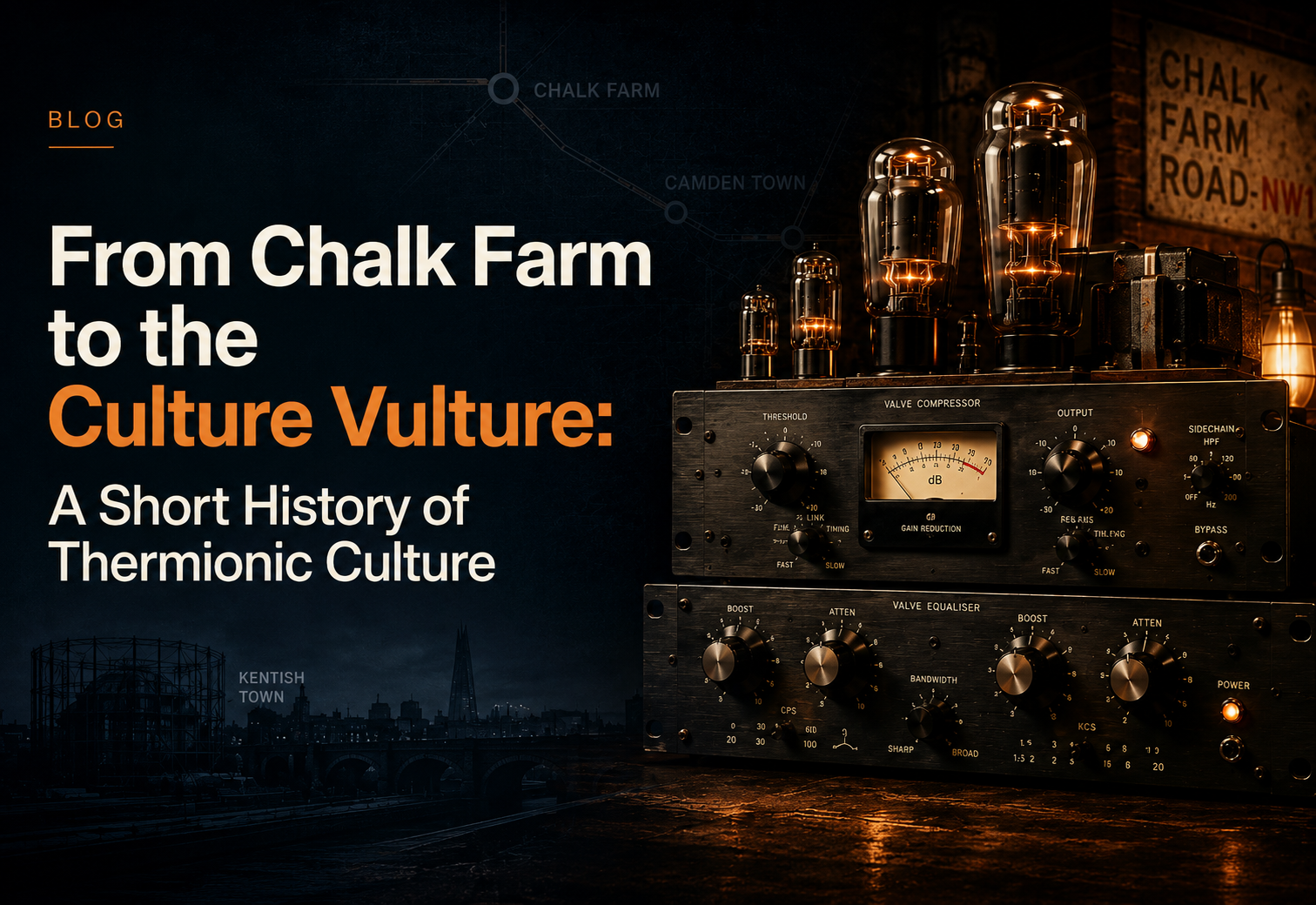
Before Thermionic Culture became known for rack units such as the Culture Vulture, it was already tied to a very specific engineering lineage: Vic Keary's decades inside studios, custom consoles, live sound, reggae sessions, and all-valve recording design.
This is not a review of Thermionic Culture hardware, and it is not a claim that any piece of equipment is automatically better because it uses valves. It is a short historical note about why the company has such a distinctive place in the history of valve-based studio outboard.
Before the company: Vic Keary, engineer and builder
According to Thermionic Culture's own company history, Vic Keary started recording in 1957, long before boutique valve outboard had become a market category. His early recording setup was practical and modest: local bands, tape machinery, and the kind of do-it-yourself engineering that makes the weak points in a signal chain very obvious.
After studying electronics, Keary moved into professional studio work at Lansdowne Studios in London. That background matters because he was not approaching audio design as an abstract vintage aesthetic. He was working around real sessions, real equipment, and real maintenance problems.
Thermionic Culture's biography notes that he maintained and modified valve recording equipment, including EMI console circuitry. That combination — studio pressure, electronics knowledge, and direct musical consequence — became the foundation of the later company story.
Studios as laboratories
For the next several decades, Keary ran and built studios including Maximum Sound, Chalk Farm, and Chiswick Reach. These were not simply rooms with commercial equipment installed. They also acted as working environments for his own all-valve designs.
The company history connects Chalk Farm in particular with UK reggae and roots recording, including work associated with Trojan Records and Keary's own label activity. That context is worth mentioning because many reggae and roots productions from that world made creative use of weight, density, space, edge, and controlled overload.
That does not mean every valve circuit is magic, or that every record from that scene depended on one technical ingredient. The useful point is narrower: Keary's interest in valves developed inside practical studio work, not as a later marketing costume.
Chiswick Reach and the bridge to Thermionic Culture
In the 1990s, Chiswick Reach introduced a new generation of engineers and musicians to Keary's valve-based recording approach. It also connected several of the people who would matter to Thermionic Culture's product story.
Thermionic Culture's Nick Terry biography describes his early fascination with using distortion as an alternative to reverb: using harmonic energy and overload to create ambience, depth, and excitement rather than simply adding a conventional spatial effect.
That idea points toward the Culture Vulture without needing to overstate it. The unit did not appear in a vacuum as a generic distortion box. It emerged from a studio culture where distortion could be treated as a dimensional and tonal tool.
The founding of Thermionic Culture
Thermionic Culture Ltd. was founded in 1998 by Vic Keary and Jon Bailes.
By then, Keary had decades of experience with studios, valve equipment, custom consoles, live sound, and record production. Thermionic Culture was the manufacturing expression of that experience: all-valve equipment designed by people who understood how engineers use sound-shaping tools in real sessions.
The company name is almost a mission statement. “Thermionic” points to valve technology itself. “Culture” points to something wider than circuitry: a way of listening and working where electronic behaviour is allowed to have personality.
The Culture Vulture: distortion as a primary control
The Culture Vulture became one of the company’s best-known products because it made a clear proposition in hardware form: valve distortion could be a dedicated studio processor, not only a side effect of driving other equipment too hard.
Thermionic Culture describes it as an all-valve rack-mountable distortion/enhancer, and the company states that the unit has changed little since its 1998 introduction. Those are manufacturer claims, so they should be read as part of the product's own history rather than as an independent lab measurement.
Its appeal is the range of possible use: subtle thickening, audible coloration, aggressive harmonic treatment, or full-on destruction. The important historical point is that it helped make distortion feel like a deliberate mix decision rather than just a warning light.
Today, saturation tools are everywhere in software and hardware. That makes the Culture Vulture easy to take for granted. But in context, its significance is that it gave engineers a dedicated, performable way to use valve distortion as a musical material.
Why this history still matters
For plugin developers, the Thermionic Culture story is a useful reminder.
If we reduce valve gear to “add harmonics,” we miss much of the practical context. The sound is not only a transfer curve. It is also the workflow around it: how hard engineers drive it, what they place before and after it, how it reacts to drums versus vocals, and why one kind of ugliness can feel musical while another simply feels broken.
For MousePlugins, that does not mean software should pretend to be hardware theatre. It means any valve-inspired processor has to care about behaviour, intention, and use-case. The interesting part is not the word “valve.” The interesting part is whether the tool gives the mixer a useful way to control density, instability, and tone.
Thermionic Culture's history is a good example of that idea becoming explicit.
After Vic Keary
Vic Keary died on October 4, 2022, just before his 84th birthday. Thermionic Culture has described its ongoing purpose as continuing his design philosophy and keeping well-designed valve audio equipment available to future generations.
That is a fitting legacy because Keary's work was never only about preserving the past. It was about using older technology in modern studio work when it solved a musical problem.
The Culture Vulture remains the obvious symbol. But the deeper story is broader: a lifetime of studios, records, consoles, valves, and decisions that helped make distortion feel like a creative instrument.
Sources and further reading
- Thermionic Culture official Vic Keary biography: https://www.thermionicculture.com/index.php/about-us?id=30
- Thermionic Culture memorial/history page for Vic Keary: https://thermionicculture.com/index.php/about-us?id=41
- Thermionic Culture Culture Vulture product page: https://www.thermionicculture.com/index.php/products/the-culture-vulture-1-17-192012-03-20-11-02-02-detail
- Thermionic Culture Nick Terry biography: https://www.thermionicculture.com/index.php/about-us?id=21
MousePlugins is not affiliated with Thermionic Culture. Thermionic Culture and Culture Vulture are referenced nominatively for historical commentary only. This article is not an endorsement claim, product review, clone claim, or technical measurement of any product.